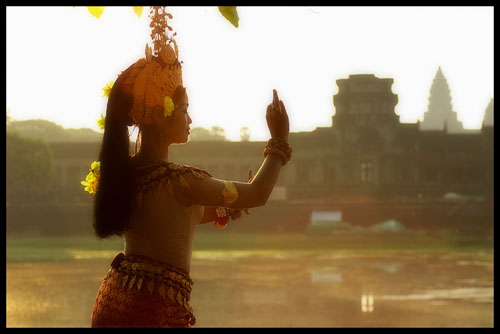
Not only did Robin Schultz, a Norman small press publisher, issue the first editions of Realization and Engendering, he chauffeured MM about as he was collecting material for half of the next book in the sequence, sonnets about Oklahoma City (my birthplace, to which Robin and I often return). Her’s second half is set on the other side of the world, where its sonnets in prose describe Angkor Wat. Designed as an epitome of the Sentence, this half Hesiodic book glances backwards to the Homeric Second, forwards to Life, which also summarizes the epic. By turning SEMREH into HERMES Her initiates a more localized version of the larger retrograde reading of the Sentence. Though the great Cambodian temple reposes majestically, Morrison, following the scholar Eleanor Mannikka, has written about it by moving through its resplendent, sacred spaces, which for the Khmers had epitomized a ritual world not altogether unlike Sentence of the Gods. MM’s full, complicated and vivid book contains many original elements, from the alternation of verse and prose commentary to other innovations in sonnetry. The opening sequence, which embodies a “crown” of sonnets, initiates a narrative in parody of the Theogony. Homeric in their comic treatment of the gods, these poems nonetheless derive even more of their spirit and detail from Hesiod’s perennially popular account of divine origins.
The full text of Her
Hesiod: Ritual Enactment and Literary Embodiment