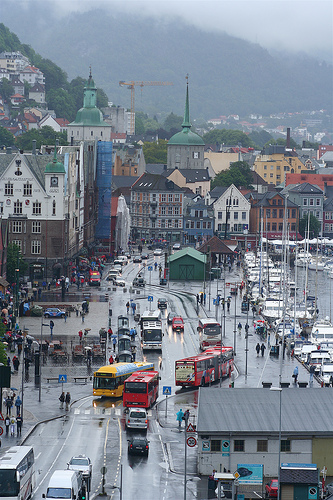
Out of Hong Kong once more, for purgatorial flight over Wuhan, Xian, Ulan Butor; on across Siberia to split Petersburg and Moscow, Helsinki and Tallinn, completing our final Baltic glide into Copenhagen. Seated next to author is a young Swede, a high school boy, returning from Guangzhou, where he has spent a month training with world-class table tennis stars. He hopes to become a computer engineer. The cabin is filled with an assortment of Finns, Norwegians, Swedes and Danes, along with a sprinkling of Asians. Seated ahead of author, in a bright Danish print, is a Chinese woman accompanied by her two sandy haired children. For the most part the Scandinavians are gregarious, even vivacious, but also reflective.
High over Siberia our course is clarified for us by a new computerized graphic. We have left Irkutsk behind, are heading for Archangelsk. Outside our cabin it is 30o below zero. Ahead, the Chinese woman’s fourteen-year-old daughter has settled into conversation with her mother; meanwhile the eight-year-old son, seated across the aisle, for the past hour has engaged author in a wordless exchange. Unfamiliar with English, he understands some Mandarin but cannot reply to questions; author, helpless in Danish, is also at a loss. To the question in Chinese, “What is your name?” author receives no response. Puzzled at first, he realizes this is not a question the little boy’s mother would ask him.
After twelve nonstop hours and nearly nine thousand kilometers, author has transferred to another flight. We are lifting off for Oslo, which we will reach by hugging the Swedish coast. On takeoff the runways of this international airport remind one of Oklahoma City. But at once we are out over the sea again. Our fellow travelers this time are mostly Norwegian. Though bluff and friendly in their way, they seem more inward, less modern, more possessed perhaps than the easygoing Swedes and the snippier Danes of an historical identity.
*
First Oslo outing, early evening scene, Karl Johan Avenue, the central boulevard that communicates between railway station and royal palace, a mile or so distant. Side walk cafés line the way, their tables sometimes four or five deep, smokers in lively conversation sipping at beers. Pedestrians stroll: girls in subdued conversation with girlfriends, guys with their dates, university students in shorts and tee shirts, businessmen in shirts and ties. An active erotic element pervades the scene. In front of a fashionable hotel, their bikes parked at the curb, members of a motorcycle gang loll with their black clad molls, pausing to rev their unmuffled motors at excruciating decibel levels. The promenaders ignore them. Most of the passersby are Norwegian, most of them blond. Parked alone at curb side: a vintage turquoise Volkswagen bug, its license plates bearing Hildesheim’s designation.
*
7:30 am Hotel Europa dining room. The deep yellow flames of a live candelabra burn atop its maroon tapers, the brass candlestick set in turn atop a red counter, itself poised above a breakfast buffet: freshly baked bread, a spread of cold cuts, condiments, fruit and yoghurt, juice, milk and coffee. A tall, portly Indian waiter, his apron and pants in identical black and white checks, clears tables, as more patrons enter: a traveling threesome of professional ladies, stylish in their various hues of blond; single diners; three middle-aged men, in vertically striped, two younger men in horizontally striped shirts. At a table sit three Chinese, mainlanders, one in early old age, two in full maturity, man and wife. A 68-year-old Scandinavian man enters, his belt supporting a Levied paunch; he sports a black tee shirt reading “Norwegian Wildlife,” a slightly comical moose depicted against a baby blue background.
8:00 am exterior view, Hotel Europe entrance. Above the door of this Rainbow Hotel, the single word “OVA.” Two tour buses are being boarded, the first by Spaniards, the second by Japanese. Two blond señoritas, one in a green polo shirt, one in a red, enter, the latter handing to the porter a black bag, on whose side read the yellow letters “SOL.” Leaning against the hotel’s exterior wall, her ample body clothed in a loose fitting white top over cream slacks, is a six-foot Norwegian girl, manager of the Japanese tour. Holding her glasses in one hand, she runs her other hand through her short blond hair. Over her white top she now puts on a light yellow jacket. Dark expensive sedans, as though in a funeral procession, head up St. Olaf’s Street in single file. Despite the bright morning sun, all have their headlights on.
Author sets out for stroll to harbor, crossing Kristian August’s Street, Kristian IV’s Street, passing on his right a gorgeous park bordering the grounds of the royal palace. High above, among its contoured berms, a worker is tending a bed of begonias, marigolds, lupine. Crossing Karl Johan Boulevard, author leaves the royal palace behind, as cyclists, descending the slight rise of its drive, squeak their brakes at the light. On across Storting’s Street, we descend another slope, past Sparebanken Nor, its “N” in red, its “o” in yellow, its “r” in blue. At the Nationaltheater Stasjon commuters are exiting. We pass a stolid complex of buildings, “United Colors of Benneton,” “Lui,” and “La Scada” jutting out into a broad side walk from their collective first floor. It is cool and pleasant. At Johan Svendsen’s Square, we pass the Oslo Konserthuset, a large moderne Norwegian sculpture forming an arch under which entering patrons must pass. To one side, also in bronze, a group of tall self-possessed Norwegians, standing together like gods, look outward and upward in different directions.
At Løkkeveien we turn to confront an agency called “Manpower,” its logo composed of half the da Vinci design of an heroic figure encircled. As a ship come into sight, author quickly turns right in hopes of reaching the water. Overhead, from a series of poles, fly Norwegian flags, the sky cloudless. A pale blue Coca Cola truck makes its appearance; it turns into a parking lot shrouded by tall poplars, across from which a clothing store whose sign reads “Joyce Joyce.” A gigantic dump truck, trailing a second, turns sharply into the street and heads back in the direction that we have just come from.
The harbor is bordered by a fancy new boardwalk, across which sit chic yuppie restaurants. Author passes a young father with two blond daughters of six and eight in tow. Boats in their berths read “Smørbukk,” “Hudra,” “Fergekroen,” the third a floating pub. Two private tour boats follow, “Hellen” and “Odins Ravn,” the latter done up in imitation of a Viking ship. On a van’s open tailgate sit two pretty girls, one applying blusher to the other’s cheeks. A tug passes, as another small ship makes its own way into the harbor. Having reached the end of the boardwalk, author comes face to face with a modern yacht called the “Challenger.” To the right a commercial loading dock is visible, red-cabbed cranes servicing a “Seatrans” vessel, as shorter cranes load the “Bergen” with six-foot diameter rolls of paper. Author turns corner into seedier side of wharf and continues, past “Sport and Fun,” where three male tourists examine a display of snorkeling gear; past “Erotisk Kunst”; past “Jimmy’s” stylish bar and restaurant, its chairs stacked neatly atop their tables. Standing out in the channel, before a wooden bridge, a nine foot bronze figure strides on wooden stilts. The air is scented with freshly cut timber.
Author turns to head back, looking across traffic roundabout, newly landscaped and cobblestoned, up a slight incline between the fronts of five-story late nineteenth-century brick and stuccoed buildings, whose perspective diminishes on up a series of rises in toward the city’s main streets. A regal Indian woman in magenta kurta pajama passes. Author crosses a railroad bridge, where two Norwegian women on the way to work smile at him, one in a sleeveless dress, the other in jeans and tank top. On the side of the bridge, in amongst ocher, aquamarine and black graffiti, someone has stenciled three stylized elephants, in red, black and yellow, the last two holding with their trunks the tails of those in front of them. As author remounts the slope already descended, left turn following right turn following left, he passes increasingly modern buildings. A blond worker in his early twenties sits on a curb, chipping at its stones with hammer and chisel, as several meters off an older man in red pants and blue tee shirt fills in with mortar the recently created gaps. Behind them a merchant is opening the door to his store, its red awning above reading in white letters, “Frukt og Tobakk.”
Author rounds corner and heads up a street with no street sign, passing a small basement store called “Inkognito Studio.” Its door is ornamented with three geometrical sunbursts, beneath them, “Free Sun,” “ProDesign,” “California Tan.” At Colbjørnsen’s Street a pale blue sparsely filled double trolley descends, as we turn into Dronningsparken, the paradisiacal grounds behind the palace. Once within the precinct we take a cinder path that winds beneath huge deciduous trees. In brilliant sunlight two pigeons peck at the park’s lush grass, still besprinkled with dew, as author continues to mount an S-curve upward toward the palace, leaving behind a kidney-shaped pond with ducks on its surface. Shifting course, he skirts the palace itself, leaving behind another kidney-shaped pond, an enormous willow dragging its branches through it. Pedestrians, few and far between, make their way to work along the park’s central asphalt pathway. A woman in shoulder-padded business suit cycles deliberately toward the exit. Higher still, two blond 20-year-olds, one with her bra-top untied, lie in the grass on their stomachs, between them in sunglasses a young man reading the morning paper.
Leaving the park, author crosses Wergelandsveien, past a Bibelskole, past IMI hotel, and continues on into Sven Brun’s Street, past Ophelia Nightclub Bar, to descend into Tulin Street, there pausing to read a sign for “Norsk Luthersk Misjons Samband.” As he arrives at Europa Hotel, a pretty girl is exiting its revolving door. “LOVE,” says her yellow tee shirt, the “O” in a sunburst.
*
Out into early afternoon Oslo, down St. Olaf's Street past blank Humanismens Hus, past its neighbor’s Romanesque lintels and gothic peak. At the corner of Pilestredet, on a wall left clear by another torn down, someone has painted a black and white version of Munch’s “The Scream,” three identical billboards beneath it advertising a candy bar called “Lion.” Overhead, cottony cumulus clouds mound in grey-shaded swabs. Across the intersection, at a single-table side walk café, three men are drinking beer, two in red shirts and blue pants, the third in a yellow shirt and red pants. Author continues on down-street past a travel agency that is touting tours of the Orient and Africa, North and South America, Australia and Europe.
We have reached a complex plaza with six streets issuing from it. High above, in its westernmost corner, construction is under way, cranes with their headlights on in full daylight. Bare-waisted, a guy of twenty strides across the square, swinging his tie-dyed tee shirt. Author exits square to enter another, where an ad for cosmetics reads “Color Me Beautiful.” A woman in long black dress and straw-white hair brushes author as she passes. A blue, accordion-pleated bus turns beneath the rust-red brick and pale-green copper trim of a tall apartment building, in whose first story is lodged an “Apotek.” Up a side street the lighted neon of the Mona Lisa Restaurant glows faintly. At a fruit stall in the square’s center, under a white awning, fresh raspberries exude their fragrance. At an adjacent stall a florist stands up, as author approaches to inspect his boxes of variegated blooms.
*
It is a cloudy afternoon. Promenading author turns into Henrik Ibsen’s Street, where a long line of cars has backed up behind a red light. As he continues to mount the street’s narrow side walk, traffic begins to pass. The incline increases. Cars proceeding down the middle lanes enter into the Vaterlandtunnel. Those proceeding forward are faced, like author himself, with nothing but grey buildings. Set at difficult angles, they draw the viewer up a darkening vista. At the first crossroad huge letters on the side of a building read “Megazone.” Up the way a sign in black on white reads “Rockefeller”; another, with a cross, “Freisens Hus.”
Things are growing darker and chillier. As we enter under our first overpass, a bookstore’s black outlined window, a bullet hole through it, advertises Norsk folk literature, a ten-volume set; the complete Jack London; the stories of Robert Louis Stevenson; Norway’s history in fifteen volumes; the history of Norwegian art. Next door a women’s naughty underwear store displays G-strings in purple, black and pink. Its white, large-breasted plastic models have coat-hanger hooks instead of heads.
Now deep within the tunnel, traffic sounds and noxious fumes increase. Overhead, yellow electric bulbs barely illuminate the filthy concrete concourse. To the right, an enormous black-on-white mural has been painted in the abstract-figurative early Norsk symbolic mode. On its surface, chalked in white, read thoroughly thought-out political statements. As traffic exits from the first tunnel to enter a second, a girl in black top, black pants and black beret cycles past, extending her left arm to signal a dangerous turn. Finally, relief, in the form of sunshine, then of ascent from inferno. Turning about, author looks back on the tunnel’s stage-like entranceway, behind which rises a grimly grey official building, its dozens of windows ranged in inevitable order.
*
Underground departure for Stavanger, compartment sparsely populated. Ahead of author, a foursome of retired Americans, two Minneapolis union members on tour of Norway with their wives, who have taken the window seats. Across the aisle, in another bank of four, a Norwegian woman in her early fifties, dressed in bright green skirt and white blouse. At author’s right, a Norwegian girl in her early twenties. We are exiting Oslo through a tunnel that undercuts the city. The middle-aged Norwegian woman stands to close the window. After a mile or so we emerge into daylight. Atop a small hill: high-gabled wooden houses, spacious and bright. It has rained during the night, but the sun now burns through a slightly hazy sky. Between tracks and harbor runs a superhighway. From each new suburb rises a neo-gothic, nineteenth-century red brick church. In an underpass two green blackboards have been affixed to the walls, chalk provided, to deal with graffiti problem. Addressing him in Norwegian, conductor asks author for tickets, taciturn Norwegian girl across aisle observing transaction. Now she stands to open her window. Author glances out at flourishing fields of grain only to have his view interrupted, as we plunge once more into a tunnel.
Arrived at Asker, the young woman opposite turns again to look at author: though angular in features, she is quite beautiful. Ahead, the middle-aged woman has apparently departed, the seat facing hers taken by balding middle-aged European man, his suntanned head topped with round brown spots. We have entered another tunnel, this one very long. As we are about to leave it, yet another retired American couple takes seats across the aisle from the two American couples. On one forearm, the husband bears an elaborate blue tattoo of a cross, on the other, the letters “USA.” We enter another tunnel. He is in black golf cap and red-white-and-blue shirt, his wife in beauty parlor do. After four or five miles we exit onto a landscape of vegetable farms. We are moving inland, though an inlet soon appears to reconnect us with the sea. Recently arrived American retiree has initiated conversation with couples across aisle. “HEROS” reads an underpass graffito, spray-painted in white on a beige tarpaulin. We slow at site of construction for a new railway bridge. On our right, a bridge for the auto route already spans the inlet, a new grain elevator also rising above the scene.
We are leaving Drammen. Carefully observing author/author activity, the middle-aged European man, a gold chain about his neck, adjusts his black-rimmed, oval glasses. With the air of a nineteenth-century intellectual, he strokes his grey-flecked beard, as he glances from one American couple to the other. Opening a map of Norway, the newly arrived American traces the route with his finger for the benefit of his wife. The landscape has begun to broaden and beautify. A green field slopes up directly into the conifer-forested hills behind it. On a rise above a rolling wheat field sits a lovely white farmhouse, behind it an enormous stable, now garage. Quickly we traverse a village, its houses amply spaced, all with broad balconies, new and old buildings alike in tiled roofs. On her way down the aisle a little girl pauses to engage author with a sidewise glance, her eyes Athena-grey. Together we pass a field in which hay, recently mown, has been rolled into bright green cylinders. The highway beside the road has diminished to two lanes, one of which has just been resurfaced. A pretty young railway employee in white blouse, junior bra visible beneath, her long hair caught in a blue ribbon, arrives to dispense coffee, as a two-propeller plane pulling a glider over-flies the train.
“Riding on a train is a pleasant way to travel,” says recent arrival, bonding with his American compatriots. He hasn’t done so since he was four. Trees now rise up to abut the tracks. Leaning forward, the angular girl glances at author, who instinctively averts her gaze, contact somehow not propitious. Hurtling through a small town, its track side station buildings a musty yellow, we soon pass the turnoff for Geilo. At the next station the girl departs.
We have reached Kongsberg, two hours into our scheduled six-and-a-half-hour trip. It has emerged that the most recently arrived Americans are from Tucson. The purpose of their trip to Stavanger is to visit the wife’s relatives. With the other couples they exchange accounts of their Norwegian experience. A middle-aged Scandinavian man in a red-black-and-blue shirt with matching shorts has entered to take seat vacated by beautiful, angular girl. We pass a black wooden house, antlers attached under the gable of its grey roof. The two American women enter upon extended review of their genealogies. Directly ahead of author, his red-white-and-blue golf cap turned around backwards to reveal the orange, red-outlined letters of his name, sits “Woody.” There follows discussion of his Norwegian genealogy, which he traces back to an ancestor who had run for the U.S. Senate in 1848. The European gent straps his black backpack over one shoulder, arises and departs. “What else happened yesterday?” asks Woody’s wife rhetorically, fishing for more Norwegian absurdities to serve as bait for a larger catch.
As we proceed through the balmy, sunlit day, there are signs that it is not always summertime in Norway: barns rise ten feet off the ground on stilts; huge snow-blowers sit by the railway tracks; in the distance looms a ski jump. The Norwegian woman in green skirt and white blouse returns, takes the seat opposite American wife. Pleasantly greeting the stranger who has taken her seat, she asks the wife if she would like to trade places. In accomplishing the maneuver she manages to split the couple, earlier seated side by side. The Americans smile and seem to accept the fact. Three minutes pass. Silently the husband stands and changes places, seating himself next to his wife again. They both face author now.
The wife, a decade younger than her husband, though plump, is well preserved, her rotund forms fitted into slack jeans and tee shirt. We have come to a small fjord, at whose northernmost edge stand hothouses for hydroponic tomatoes. She has kept up her makeup, rouge on cheek, eyebrow penciled. We pass two horses put out to pasture, one dappled, one caramel. But her frosted hair, in the American late-middle-age fashion, is almost comically short. Passages of road side foliage obfuscating the landscape, the view suddenly opens up onto a pie-shaped golden wheat field, rich unripened grain fields on either side of it.
Woody and Phil, his cross-aisle interlocutor, have identified a common friend, a famous baseball coach of university teams in Arizona. Phil, a Tucson resident in his fourth year of retirement, has known him, he says, since he was “yeah high.” Forty years ago in Minnesota the coach was a student of Woody’s, then instructor in a bowling class. We view a line of distant farms over a wide river, their white houses and rust-red barns a hundred years old. Having passed through Bø we stop at Lunde. The forest deepens. We enter a long tunnel. The track side road has degraded to a double rut, beige soil and gravel, an up-growth of grass in its middle. Soon it too disappears.
As we approach Neslandsvatn, the first beech-like trees make their appearance, intermixed with conifers. The terrain has become much more inhospitable. As we skirt a lake, a little butterfly jumps the water’s embankment and rises toward the train. A fire brigade relaxes under a stand of tall trees. The track side road reappears, on it a fire truck. Before long, smoke fills the air. All at once the track side road veers away, only to return several moments later with equal abruptness.
Four hours into our journey, the American conversation has turned to golfing in Tucson. As we idle at the station in Nelaug, several dozen swallows, at first tentatively, then rushing in pairs, settle on the electric lines. Having rested for a moment, all quickly depart. Talk turns to the size of counties in Arizona. Once we are under way again, the view opens into a yellow-green bog. A stand of conifers emerges from its midst, as though topping an island. It is 3:30, another hour and a half to Stavanger, or so the timetable says.
The foursome has settled in for a nap, Phil and his wife commentating the surround. In the confidential tones of pillow talk they discuss author, Woody, the Norwegian woman seated opposite. They look out the window together at the gorgeous landscape. Phil and his wife, it is clear, are still in love. The terrain grown even more rugged, the roadway is now scarcely wide enough for two cars to pass. At every turn he treats her with consideration; she for her part tolerates his glances at the beautiful service personnel. Suddenly the view opens out upon a fjord lined with garden plots. We experience three consecutive tunnels, as though they were three magical passages. We skirt a field of fledgling beeches, in amongst them taller trees, like chicks with mother hens. We pass through another stand of fire-destroyed timber. At several points, not often, but profusely, a heather-like plant covers the ground. On the smaller fjords vacationers paddle yellow canoes.
As late afternoon approaches, our train begins to pick up speed. We are on a decline, hurtling westward. Our rate of descent also increases, enough to make one’s ears pop. We are heading down a valley, out to sea. As we lose more altitude, the road rejoins us, broadening again to two lanes. We dip to beneath the level of the road, until it dips to yet a lower level, passing beneath us. A public address announcement predicts our imminent arrival in Vennesla. We traverse a tunnel, emerge and decelerate into the station. Leaving Vennesla, we recommence our descent, entering into a noisy tunnel. We reemerge into the light, our rate of descent increasing again. Houses rise up to meet us. Departing from the bank of an inlet to nestle under the mountain side, we suddenly enter a long tunnel, emerging alongside the inlet’s waters only to enter yet another tunnel. As we exit, we look far down the inlet toward the sea, which is still not in sight. Another long announcement in Norwegian has informed us that we are approaching Kristiansand. Once we arrive, it says, please reverse the position of your seats, for we must back out of this coastal town to continue our progress toward Stavanger.
We have left Kristiansand and begun to retrace our route. The tracks divide,
this side of the Y indicating our northwestward direction. The train is running
far behind schedule. With two and a half more hours
to go, we will not
arrive in Stavanger until after 6:00, eight and a half hours after departure
from Oslo. The view at this point is badly obscured by track side up-growth.
Occasionally, though, we look down to glimpse whole villages seated in broad
valleys. We slow down and finally stop, in the midst of nowhere. Someone has
failed to throw a switch that would have shunted us onto the right track. We
must back up a quarter of a mile for the task to be accomplished. We have
fallen even further behind schedule. Under way again, we enter into a very long
tunnel. The compartment, having warmed up under the afternoon sun, rapidly
cools off. The inane American patter continues: mindless comments about the
weather, jokes based on mispronunciation of Norwegian names. Fortunately, two
of the three couples will be departing at the next station. We enter into a
broad valley, where horses, sheep, and cattle are all grazing in separate
fields.
We have reached the original American couples’ destination. Waddling down the aisle they painfully debark, detained by their great girth, excessive luggage and silliness. In the background, awaiting them, stand a dignified Norwegian mother and her daughter, fearful that the relatives will fail to get off the train. Briefly we glimpse a scene of reunion, then head into a long tunnel. Approaching Gyland we must wait for a train to exit, before we can enter another tunnel. The mountains have become more massive, rising to twice the height of earlier peaks. We pass a scene of innocence, children bathing naked in a lake. On our left opens a broad fjord, along its farther bank a town called Moi, into which we now descend. From its private flagpoles fly thin triangular pennons bearing the cross of Norway. Once out of Moi the landscape takes on a grander authority. We traverse a mountain side gashed with vast natural axe-strokes. Across a bay of blue water appears a cliff side completely covered in dark pines. We have entered another dimension of Norway, one in which nature has wrested from man the greater identity. Beneath us a tiny red car winds along the side of a blue lake.
After a brief stop at Egersund the weather abruptly changes. The landscape turns somber, blue skies within minutes becoming overcast. We have entered upon a coastal plain, arable, but only exiguously so. Cultivating it requires that one remove large rocks deposited by receding glaciers. Some industrious farmers have done so, making of the boulders barriers to separate their fields. Some, less industrious, have piled the rocks at the centers of theirs. Quickly we pass through villages strung out along the track, now set back a mile from the sea. As we continue on, fields grow increasingly broader, some sown in a lush grass, recently harvested or in the process of being cut. In the least arable, sheep are seen grazing. Those of richer soil support herds of cattle. Those not being grazed are under cultivation, large barns at their margins ready to receive the summer harvest and shelter livestock during the winter. We hurtle through village after village, scarcely batting an eye. Gradually the undulant scene flattens out and we stop once more, in a dreary industrial town called Bryne. We are almost to the suburbs of Stavanger. It is 7:00 o’clock, nine hours since we had left Oslo.
Stavanger, 8:00 pm. A bright sun raking the fronts of yellow, rust- red, dark blue, houses reveals them in their most saccharine aspect. Author strolls in among them, the streets of the old town all but deserted. We head for the harbor, where black, white and red vehicles, their headlights on, approach along a double lane of asphalt, a brilliant carpet of emerald grass in its median. Like two immense tuning forks, pylons support a suspension bridge. Across the harbor the green arms of a tall red crane await business. At its stern a ferry churns a stream of white foam out of the blue sea. On a grey wall an heroic yellow graffito reads “VIKING.”
A white guy with his gorgeous black girlfriend passes. Three blond teenagers head up the hill, author following in hopes that they will lead him to signs of life. We pass a park, where an eight-year-old Indian girl is dancing by herself. Another level achieved and the mountains surrounding the harbor come into view. Author, now alone, passes a graveyard, its gate left open. On the wall of a four-story stuccoed building, the cutout forms of immense doves, their wingspans nine or ten feet. Crossing a bridge over a small valley, author enters Kirkegårdsveien, remounts Mégata and returns to his immaculate guesthouse.
*
Departure by express boat for Bergen, with a midway change at Leirvik. Skies are overcast, as we glide smoothly out of Stavanger, past oil barges, corrugated lodgings atop them. The harbor is lined with industrial sheds, cranes rising above pine trees. The boat’s seats are scarcely half filled, mostly with teenagers. Boarding the ship, they absorb themselves at once in books. Author engages in conversation an utterly gorgeous sixteen-year-old girl returning home from her summer’s work. She lives in a small village along the Nordfjord, far north of Bergen. Other passengers in their late twenties and early thirties buy beers and settle into their seats for conversation. It is 9:00 o’clock in the morning. Once out of the harbor, we increase our speed to 35 miles an hour.
One of the pleasanter features of Norway is that one is always addressed in Norwegian. On the train yesterday the 20-year-old railway employee asked author what he would like to eat, in Norwegian. At the guesthouse this morning, as, unbidden, he served author an English-style soft-boiled egg with two pieces of toast in a salver, the jovial, white-haired, red-faced, six-foot-four-inch owner, asked him, again in Norwegian, whether he had slept well. Later, at the ferry dock, he was asked, in Norwegian, what kind of tickets he wanted.
Having cleared the peninsula and headed out to sea, we must round a cape before veering north. According to the map our journey will take us past offshore islands that obscure the actual coastline of Norway. The seascape without interest, author takes seat in the row ahead to engage sixteen-year-old in further conversation. She is tanned from her summer, her nose aquiline, almost perfectly straight. Author expresses interest in her book. Though her lips are full and pouty, her fingers are long and slender. He tells her that he himself is a writer. She wears her hair in a boyish, layered shag, long bangs descending to her eyebrows. She herself a poet, her costume has been carefully chosen: silver necklace, tweedy jacket, black tights. We must write a poem together, author says. Karina smiles, her gold nose ring glinting.
Quickly the weather has changed. Author returns to his seat, Karina to her book. Two-thirds up the eastern sky the sun has broken through. We are maintaining a constant speed of 50 miles an hour, past a landscape increasingly bleak. In a small boat two orange-jacketed men are dwarfed by the water’s expanse. We have settled into a northwesterly course. At some distance, directly north of us, stands our first ship, its black hull floating along the horizon line, its white upper stages blending into the bluish haze of horizontal cloud. Across the aisle from author, two 28-year-olds are starting in on their third beers. Karina stands, leaves her seat and heads aft along the aisle, her eyes flickering for an instant as she passes author. Demurely she averts contact with any other passenger. We approach an island. While she is gone, we pass its shoreline in a single motion, dipping beneath a bridge that connects it with another, farther out to sea. Author decides to venture forth on deck.
Standing against the stern’s blue railing, he gazes over a triple-rooster of spray jetting out from the ship’s propellers. A bright turquoise plastic line has been strung across the stairs, prohibiting admittance to the upper deck. The motion of the ship is nothing short of terrific. Foam jets out from her sides like fresh-churned intergalactic matter, frothing onto, receding into the sea’s blue surface. We are passing a rugged island, its shore composed of long stone lozenges, only a bristly scrub of pine topping it. Suddenly a much closer island heaves into view. Quickly we leave it behind, awash in our tremendous wake.
Joining author on aft deck is a statuesque middle-aged woman in black hair, black skirt, silver-tipped shoes. Over black coffee she takes a final drag on her cigarette. Another, much younger woman, sits in the portal, prohibited from entering by her black, three-foot-tall Labrador; tethered, he nonetheless threatens passengers who venture onto the deck.
We have paused at a town of perhaps 20,000 people to take on passengers, its two-storied harbor side houses uniformly broad and gabled, all set cheek-to-jowl.
We have entered a somewhat larger port, its harbor filled with many pleasure craft, including a yacht named “The Happy Taurus, II.” Here wooden buildings are complemented by higher brick and stone structures. A lanky 20-year-old, her blond hair floating in the breeze, strolls the dock. The town is putting on its summery air; one can barely imagine how it will look in winter. Having left the town and its harbor behind, we enter onto the open sea. The sky grown cloudy, the wind picks up. To delighted squeals from the kids in the cabin we launch out over two foot waves. Rain begins to streak the windows.
Author passes ahead on a piece of paper a question for Karina: who is her favorite movie star? The answer: Johnny Depp. What is her favorite color? Blue, she says. With time to examine his written English, her responsiveness improves. Before long Karina and author have entered into correspondence, she adding untranslatable details in Norwegian. To break the rhythm of question and answer, he composes an ode to her beauty, in suitably simplified English verse. A long pause follows. Between the seats ahead peeks a sheet of ruled paper, on it a poem for author, in Norwegian. At Fråleirvik the two lovers debark. In the bright sunshine they stand together, waiting to board the new ship. On the surface of the water, oblivious to the dock’s noisy activity, a single little duck ruffles its white feathers.
The second phase of our journey is spent in the smoker’s lounge of a more luxurious ship. The seas have quieted. The new decor is mauve and purple. Karina, who hand rolls her own smokes, is fifteen and a half. We have taken seats – the last available – at a glass topped table for four and now sit cattycorner from one another. The other smokers in seats beside us adopt a languid, late morning attitude. As Karina and author begin a new poem, passing it line by line back and forth, they express a mild interest, though more in the poem than anything else. Glass panels partition the groups of lounge seats surrounding the tables, each panel etched with a white outlined, white winged, white beaked swallow.
Karina has left school this past year to work on her parent’s farm, where the family raises hydroponic tomatoes. This summer she has worked as a kindergarten teacher, a profession she hopes to pursue. She plans further study, perhaps at a college. Her family includes an older sister and two younger brothers, one four years old, the other killed this past year in a car crash. Author learns of these details over lunch in Bergen, where we linger for two hours. When Karina opens her wallet to show pictures, out falls a sheet of five or six telephone numbers, beside them a scribbled heart. These, she explains, are the people she loves. Lunch finished, we go in search of the tourist office, where she arranges author’s stay at a private house. After a brief walk to the dock he must say farewell. It is 4:00 pm. Karina boards the ship to await its departure, as author heads off to private house, so as not to keep its matron waiting.
Bergen, 8:00 pm, third story room of private house, through whose high fenestration a church tower, its steeple sheathed in elaborately worked copper. Like the western sides of the white houses below, it catches a steady stream of light from a sun that seems to have stopped declining at 4:00 pm.
*
Saturday morning harbor side market displays, accordion with spoon on washboard accompaniment: Norwegian caviar, Russian caviar, salmon paté. Lox on bagel with cucumber slice. Norske reker, French fish, catfish, turbot, monkfish. Pickled herring in mustard sauce, in tomato sauce, in sherry. Personnel behind the white oil cloth covered counters are bright and efficient, all clad in heavy orange fisherman’s pants. Author past fruit stand, vegetable merchant, display of pelts: red fox, golden fox, blue silver fox. Pleasure craft, mostly Norwegian, line the dock. A German, having just arrived, cleans the windshield wipers of his private cruiser, the “Barracuda.” A black hulled cutter, the “Grinna,” is tied up ahead of him. Farther along, the Bergen fire department makes its appearance, in a boat, a large van, a Toyota minitruck, a small fire truck, all in different shades of red. The occasion for their convention is unclear. Behind Global Spedisjon stands a sleek Plexiglas yacht, the “Surama” of London, two white panted, baby blue shirted, barefooted crew members tending its lines and lifeboat. Low in the water, next to two tugs, nestles the white hulled, blue striped “Pollux.”
A 50-year-old man, his long blond hair pulled back in a pony tail, sits cross-legged, leaned against a ten foot high spool of yellow telephone cable. In a notebook poised atop his rucksack he is writing a poem.
We pass a church, its squat, white wooden tower surmounted by an onion dome. Medieval buildings emerge, their ramparts crenellated, a stonework tower rising high above them, three tiny red bordered windows near its top.
Author faces the goal toward which he has been heading: two substantial ships docked at the harbor’s entrance: the yellow and black “Monika Viking,” a rescue vessel from Kristiansand, and the “Costa Allegra,” a creamy grey cruise boat from Italy. A large black-cabbed Volvo transport, a sea green container on its blue bed, turns into Bergen Fiskeindustri at the mouth of the harbor. Passengers are boarding the Costa Allegra. Across from her, only now come into view, is the luxury liner Europa, her grey hull striped in orange and blue.
At the end of the dock, old-fashioned ropes secure the Europa and the Costa to the same bulkhead. The few tourists still waiting to board are promenading. Two Greek-speaking hands, in blue zippered sweaters and white paint spattered overalls, descend a ladder to a tiny raft, disappearing below the dock, at the end of which stand two old men, dressed in inexplicably elegant ways. One, an Italian gent in a brush moustache, black trimmed grey jacket and cloth slippers, inspects one of the lines holding the Costa in its berth. The second, in black jacket, cane and grey fedora, turns to board the Europa. Meanwhile, a purple three wheeled souped-up road cycle thunders onto the wharf, its driver in black leather pants and jacket, a long black scarf about his neck. At his bike’s rear is a traveling cabinet, on whose surface the silver outline of a naked girl. The biker dismounts and strolls to the end of the pier, where he too tests the heavy cordage. Now he is joined by a girlfriend, in tasseled leather jacket, fringed leather pants, blond unkempt locks.
A red taxi-van arrives to deposit a group of expensively dressed tourists at the Europa’s gangplank, preparations under way for her departure. As author clears the ship, a new landscape opens up on the northern flank of Bergen: houses, dwarfed by a beetling cliff, sympathetic in their regularity and harmonious color schemes. Exiting dock side, author encounters a huge white-cabbed, red-bodied Renault truck, its side panel reading, in a never before seen style, “Cilerci, International Transport, Istanbul, Türkiye.”
Turning up Skutevikstorget, we leave modern Bergen to enter Bryggen, the oldest part of town. The road takes us behind Norsk Fiskeindustri, whose loading docks not surprisingly smell of fish. Across the way at number 7, a man in red shirt and blue pants works at repairing his little white cottage. Farther on, the granite mountain comes down to meet us, yellow daisies peeking up out of its crevices. We have reached a parking lot for camping caravans. On the rear panel of a Mercedes tour bus a popular artist has painted a romantic Dutch landscape: windmill and sunset, both in red and yellow. Distinguished little wooden houses line the opposite side of the roadway, one in maroon and olive trim. On this side a sign advertises “Michigan Propeller.”
The highway ahead promising nothing new, author loops back along Nye Sandviksveien, whose house fronts are graced with roses, poinsettias and potted pansies. At the end of the street a house painter on break holds forth at the center of a five way conversation. Beside a red outlined telephone booth we pause to look out over the retiled roofs back down into the harbor. From high above, the Europa stands complete, her foredeck whitened by the sun.
As author continues descent, ahead of him two twelve-year-old darlings, in identically blond ponytails, their skinny legs squeezed into tight-fitting jeans, hoof it into town for Saturday afternoon fun. Reaching her slender arms and graceful fingers behind her head, the taller of the two reaffixes the rubber band that holds her hair in place. The girls keep a distance from one another, nudging closer from time to time to whisper secrets. Author turns harborward, passing a tall medieval church, a bronze elephant standing high above a drug store’s entrance. He pauses before the statue of a young man who had sacrificed his life for the fatherland, then before another in memory of Snorri Sturlason, the date on its side 1178.
*
8:01 reads the Coca Cola clock at dock side, a girl in a green sweatshirt, an older man the age of her father, jogging past together. We are backing out of our berth, headed today for the Sognefjord and points along it: Balestrand, Vangsnes, Flåm. As the ship pivots, we face the aperture of the port, through which the North Sea Surveyor is entering. Picking up speed, we pass the tall medieval tower with its little red windows and onion dome; the Monika Viking, whose lights have been on all night.
“Man Overboard. (1) Throw life buoy into the water. (2) Notify the crew,” reads sign on seat ahead of author. We have reached the end of the dock, where two young men stand talking, hands in their pockets against the chill. The Europa has departed; likewise, the Costa Allegra. Smoke issuing from four stacks, her white silhouette reading against the cliffs, the Arcona from Rostock crosses the bay. As we leave her behind we accelerate to 35 miles an hour, entering onto a dark grey slate of sea. We pass a twelve tiered grain elevator and round the cape. Along an increasingly distant shore, in among high-rise towers, on through trees in a more sparsely settled terrain, a yellow bus threads its way.
We are half an hour out of Bergen, standing off from another town, the cliff face behind it allowing for only a thinly etched roadway. There is virtually no arable land here. A crook in the coast provides shelter for a small marina, behind which commercial buildings. Then, nothing but rocky coast, a single house perched high above.
We glide beneath a suspension bridge, which descends from high to low, as it crosses from mainland to offshore island, its paired cables elegantly interwoven. Once past, we point northwestward and accelerate to 40 miles an hour. The coast here is populated with rather large, newly built suburban style houses. Across the white railing of our prow lies a bright green polyester line, two strands of it opening and closing in the wind. Rain drops begin to whiten the surface of the windows, as we head shoreward and cut throttle, presumably in preparation for our first landing. Five gulls fly in a pseudo formation against a background of granite cliffs marked by water runoff. We settle into a riparian channel, standing but a dozen meters from the mountain side. We approach a town past abandoned storehouses, older inhabited structures, newer ones, past wild intermittent growth. Trees have fallen into the sea; boulders obtrude into the channel; cliffs rise abruptly. There is no road.
So thoroughly patterned with rivulets are the ship’s forward windows that those who had rushed to take seats behind them are now dismayed. A Swiss girl, encountered yesterday at the tourist office, opens a portal and exits onto deck. Meanwhile the ship’s conductor works the aisle with his array of European equipment: leather purse, leather pouch, ticket puncher, coin changer, ticket machine. We have not stopped after all. Instead, we pick up speed and purr forward, attended only by the quiet of the landscape. Like skeins of carded wool a cloud drapes itself over a small mountain, a solitary white house punctuating its forested face. Along the coast a bright yellow fishing shack shines like a beacon. After a village carved out of the cliff side we suddenly leave behind the civilized realm, deciduous giving way to coniferous growth. In the now much more rugged landscape single cottages appear at intervals, one per inlet. Rounding a cape we leave all behind but nature herself.
An hour out of Bergen the coastal mountains have receded inland, the shore uninhabited. Gradually things improve. The sun having broken through, red barns and square white houses begin to appear, receiving its benevolent illumination. On the flatter slopes farming recommences. We pass a white church with a black steeple, three grey gulls descending upon it. Then rocky outcrop quickly supersedes farmland. Battling against the head wind, a single gull makes its way out to the end of a promontory, from which a single fir tree rises.
Author has stepped out on deck. For the past hour he has been talking to a French woman in her mid thirties, a professor of physics. We are moving more slowly again, through a narrow channel. On her month’s vacation she is touring Norway. Another gorgeous concrete bridge spans the flood from shore to offshore island. Her field is solid state physics, with a special interest in thin films, magnetism, magneto resistance, neutron diffusion. The rocks here, presumably igneous, are striated, their black surfaces veined with white. She is the youngest of several sisters, the others all married. Author tightens yellow rain jacket against the breeze. Her hair is Scandinavian blond, her eyes a Nordic blue. We are exiting from the double clutches of a narrow shoreward passage into a wider inlet bay. She is married to her work, which has taken her to conferences abroad. It begins to sprinkle, heavy clouds lowering.
We prepare to make our first landing, at a very small port. The single debarking passenger is called upon to tie the bright green line to the cleat. The rain has darkened the dock’s concrete surface. The expanse of nature is empty, the only sound the crackling of our ship’s radio. We are off again. Amid a grove of evergreens rises a white Lutheran chapel, its roof in grey. We peer through the mist at a rust red boat house only to return to a rainy, rocky deserted coast.
As we cross the mouth of an inlet, a rip line indicates the motion of the incoming tide. We leave a cove behind, its shoreline mountainous. At Soleibotn we prepare for our second landing. A drizzle commences. An attendant awaits the toss of the green line. Secured at our bow, we mechanically lower the gangplank. When it touches down at the stern, two passengers, a man and his wife, her jacket pulled over her head, step on board. Having caught a parcel of plastic covered newspapers, the attendant hustles to our bow to cast us off. Standing on deck, a Japanese tourist videotapes the scene, his wife, in a Mickey Mouse sweatshirt, framed for the shot. Behind them an American woman in turn photographs the Japanese, her six-foot-two daughter standing at her side.
In a roiling broth of fog we enter the broad mouth of the Sognefjord. Before long, as we begin our approach to Lavik, the sun breaks through. Over the town dock flies a flag, a quilt made up of the flags of many nations.
Author to deck for fjord inspection. We pause again to let off passengers, approaching a cliff that rises sharply above us, its top hatted in cloud. Along the narrow coastal road winds a line of vehicles. A gull, rising and descending, flaps its way across the open gorge. As we cross to the opposite side, the wind picks up considerably, making the use of handheld recorder impossible. We veer back, round a cape and return to the fjord’s center, where the wind whips the bluish green surface of the water, capping it with waves. Up a crevice, on the second tier of peaks: our first glimpse of still unmelted snow.
Another hour passes in conversation with professor, as we move eastward through a progression of mountain ranges, the sun casting its beams on the fjord, heavy cloud covering the more distant peaks. We are more than half way. Author exits onto deck for exhilarating 50-mile-an-hour glide into Balestrand. Heading straight for a church, we change direction, veering toward a nineteenth century wooden tourist hotel, its three stories in elaborate carpentry. Through clearing clouds we again look upward to much brighter patches of snow.
Balestrand – we have reached our first big destination – seems little more than a village. As the ship lays her flank against the dock, we face back out into the fjord, a single brilliant line of white sunlight striping its center. Two Japanese kids in white short shorts circumambulate the deck with two newfound western friends. Once back in the cabin – author returned to protect seat against influx of passengers, the Captain begins another discourse, this time on the myth of the Viking king, who, grasping his sword hilt, rises in the midst of a green field on the opposite side of the fjord. We recross for landfall at Vangsnes, a view opening behind us of the larger passage through which we have come.
Author talks to Norwegian sailor, who tells the story of his recent unemployment. Educated, experienced and technically qualified, he has lost his job to foreign labor. Only the captains and mates of today’s vessels, he explains, are Norwegian. Ships pick up their crews in the Philippines. Backing out, we shift gears, turn and are under way, heading once more into the blue grey, green shadowed, ever-changing waters of the fjord.
On our approach to Flåm we are making our third landfall within half an hour. Author to front of ship for through-window observation. Promenading on deck, with American grandma and six-foot-two-inch mother, is the Japanese mother, all four kids alongside, Mickey Mouse smiling. “Hotell,” says a sign at Leikanger atop a two-story wooden structure, its concrete modern annex half hidden behind it.
We have long since entered the Aurlandsfjord, an inlet off an inlet, and are now passing the mouth of yet another, the Naer Øyfjord, which in turn debouches into the second inlet. “This,” says the Captain, “is one of the narrowest fjords in Europe, the only access by boat.” A ship with red striped black stacks is exiting it. “One famous Norwegian lived in a house up a cliff so high it could only be reached by ladder,” he says. “When the tax collector came, he just lifted up the ladder.” We enter the narrow harbor at the town of Aurland, almost in sight of Flåm.
Established at guest house, author heads out of Flåm on foot, past 1940s railway, with its silver trestle and quaint transformer. We cross a wooden bridge over a mountain brook so clear that its bottom is visible under three feet of water. At the head of the harbor stands a huge propeller, once part of an Estonian ship, “sunk by the Norwegian militaries,” the plaque says, “after German planes had bombed her, April 5, 1940.” Cottonwoods rustle in the shade of a cliff behind us. ”The Estonian captain, Mihkel Kekägi, was killed in the attack.”
Leaving the little town’s outskirts, we ascend a highway, scarcely a lane wide, past an old hotel, many of its windows broken out in back. Out in the bay a single prop plane with pontoons is landing. As though in imitation, a large gull dives toward the water’s surface. Author looks down onto the heads of three Korean tourists also climbing the mountain. As we round the bend, a burst of spectacular scenery greets us: an orchard of low-lying fruit trees, at their feet a blanket of luminous green grass; a mountain base covered with whispering aspens; above, a dark interval of conifers, almost black in their shadowed recesses. The single prop plane, having taxied back out of the harbor, now revs, strains forward, slowly gaining speed for its takeoff. Gulls flutter from its path. After 300 yards it is still not off the surface of the water. Another hundred yards and it is barely skimming the waves. At last, perilously close to the opposite shore, it lifts off, veering to avert the embankment. As it heads on up the fjord, its little drone continues to echo.
The skies have begun to scumble over ominously, author questioning the wisdom of having left on a hike without rainwear. He has crossed the fjord and entered a smaller road poised below a highway exiting from a tunnel. “Aurland, 9 km,” read the black letters on a yellow sign; “Hella 100”; “Oslo 336.” Down the highway roars an eighteen wheel Ringnes beer truck, on its back panel: two six-foot glasses of frosty brew. We reach the site of a large cascade, whose flood here rushes under the highway. Eager to follow the waterfall to its source, author defers to portentous skies which suggest that return would be more prudent.
As he re-approaches town, a black hulled cutter makes its way into the harbor, its white upper deck lit by a brilliantly re-emergent sun. Down the gorge the sunlit single prop plane is also returning. All of a sudden the light goes out, the water’s surface sullen. Descending author accelerates pace, past broken out windows of hotel, hoping to reach port before the cutter enters, before the plane lands. Approaching the dock, the boat reverses its engines, churning up a white and light green froth on the suddenly sunlit rippled surface of the water. As author reaches the dock, out in the bay the little plane touches down. Returning past railroad station, he retraces route over wooden bridge, an electric train humming toward Myrdal behind him. Once across the mountain brook, he circles back to the garden of the guest house, past fruit tree and flower bed, to an already opened door.
*
Pre-departure mid-morning stroll east of Flåm, view of mountain side cascade, mountain side meadow, mountain side brook, light effulgent, sides of white clapboard houses especially bright. As clouds encroach, the sun infiltrates them, banding the mountain side in white. It is still and cool.
Flåm station, 11:25 am, awaiting train for Myrdal. At the end of the platform a sign reads “Supermarked.” A group of German tourists, middle-aged, corpulent, self-satisfied, volubly commentate the scene; the Scandinavians take no offense but themselves are more polite and introspective. Author takes seat in empty compartment, which begins to fill with young European backpackers, their tents, parkas, rucksacks in purple, lavender, turquoise. On the platform outside stand two railway personnel: a six-foot-three-inch man in very pale blue shirt, one arm akimbo; a melancholy boy in a dark blue suit too large for him, hands clasped behind him. With a burst of compressed air the doors shut, and we are off, past yellow station side buildings, under a silver trestle, past brook, meadow, cascade. The trip to Myrdal covers only twenty kilometers but will take fifty minutes. Tentatively the melancholy boy checks our tickets, a faint smile on his lips. We pause at Lunden, scarcely a kilometer out of Flåm. Two immense boulders in the midst of the flood have had wooden walkways built about them so that they may be circumambulated. Quickly we begin to scale the mountain side. Within another kilometer we arrive above Håreina, looking down into the red roofed village over raspberry fields.
At the end of the gorge the flood rises into rapids. We have climbed to 60 feet above them and peer back down onto a solitary angler fishing with a twenty foot silver pole. Ascending farther toward the ridge, we enter our first tunnel, exiting to face another cascade, its water free falling. We continue upward, our speed slowing to twenty miles an hour. Snow patched mountain tops, greened with new foliage, appear through the openings. We enter a second tunnel, glimpse the flood and enter a third. Exiting, we follow a ridge to the opposite side of the crevice. The Germans scurry across the aisle to occupy every available window seat. In the distance, another cascade, beneath which a group of houses, all crouched on a slanting shelf of rock. At Verekvam, the ten kilometer mark, we must pause for another train to pass. Beside the track lie freshly chopped piles of wood. The train for Flåm arrived, we recommence our ascent, laboring at the incline. We emerge from a tunnel to face a downrushing stream. High above, a mountain cap is melting.
Soon we too have reached the snow line. Traversing a long curving tunnel, we open out onto a light turquoise froth of rapids. All at once we enter another tunnel, three times as long as the last. Laboring to ascend, we exit slowly onto a platform to rest. Before us rush, with violent force, the riverlike waters of the Kjosfossen. Ninety three meters high, its creamy flood thunders, churning downward out of nowhere, disappearing beneath us. The sunlight, striking its turbulent surface, clouds its mist. Behind glistens a black cliff. Under way again we traverse a series of tunnels, glimpsing through brief apertures an intermittent scene of rugged beauty. Within minutes we have reached the lake out of which the roaring cascade had issued. Pausing at Vakahalsen, where middle-aged backpackers board, we arrive at last at the green mountaintop town of Myrdal, where the Bergen train for Oslo awaits us.
Author takes seat opposite handsome, black clad Norwegian youth.
Behind dark glasses his eyes are closed, his fingers holding in place the earplugs of a CD player. In his early twenties, the long strands of his blond hair are caught in a pony tail. A beautiful redheaded girl of twenty returns to take her seat next to author. And we are off. Even though near the ridge of the mountain, we enter a tunnel at once. Exiting, we pass directly into a series of sheds built to protect the tracks from snow. We look down onto a large lake. At the end of the snow shed we pause, gazing up at a scene of blue sky and single unraveling cloud. Under way again we pass through shed after shed, through whose internal apertures light flickers in experimental film like sequences. We are viewing mountain peaks from almost mountain peak level, looking at lakes from the level of their sources. Surprisingly, even at the summit there are signs of habitation, houses wedged in among lichen-covered squarish boulders. We enter a long shed, light emitted into it as though by photon bursts. As we begin descent, the sound of the train whines down to a lower register. A girl in shortly cropped blond hair gets up and leaves, closing the compartment door behind her. Exiting a tunnel, we enter onto a rock-filled scene interwoven with streams, in the midst of which sit solitary cabins: black, brown, dark red.
We have arrived at Finse, official railway buildings in black. Their first story, red curtained windows reflect the train itself. On the hill side above stands a black house in red trim. As we leave the station, we enter a waste land. Atop a mound of stone, a single turquoise tent makes its appearance. Gradually we descend to lower altitudes. Little lakes open up to an ampler lake, along whose shores are distributed a few camping vehicles. Out of lakes, streams begin to flow eastward. In this region wooden snow baffles, twenty feet high, have been constructed. Some, badly damaged by the force of the wind, have yet to be repaired. In amongst a huge field strewn with angular lichen-covered boulders sits a single backpacker dressed in red and black. We have now descended several hundred meters to stop beside a lake, whose name is not indicated by any track side sign. The mountainous clouds have attained a midday stasis.
Through the first few hours we have passed from mountain peak to rocky decline to valley descent. Now the rolling landscape, though still forested, begins to support farms on its lower slopes. Meadows emerge, only to be erased by forested hills. By the tracks a stand of conifers is interspersed with younger deciduous trees. The fields return, yellow and green silage with beige grain.
Descended to yet lower levels, mountains now surround us. To the east, a blue grey purple range, to the south, a ridge of forested green. As we slip on through the landscape, towns become more frequent: station, soccer field, school and church. We reach Hønefoss and pause, its station house a deep yellow stucco layered with courses of red brick. As we are leaving the town, we survey its large handsome houses. For two hours author has been talking with Kvasti (read “Shasti”), a lovely freckle faced girl from a large family that lives on an island south of Bergen. Her older sister has recently married a Swede. She herself spent this last year in England as an au pair girl, an experience which has left her with a lower-class London accent. In the East of the city she met many Africans and Asians. The Caucasian Englishmen, she remarks, “are so lacking in color, their clothes so drab. Black and white, black and white!” She is on her way to Oslo to look for a secretarial job. If she cannot find one in two or three days, she will return home. Clearly she comes from a happy, affectionate family. Her mother, only 42, wears the same size dress that she does. Mildly curious about Asia, Kvasti is shocked to learn that author’s elder son has married a Chinese woman. She feels that communication with a Swede would be difficult enough. When she marries, not too soon, but “certainly by 25,” her husband will be her own age. “People 39 and 22 are too weird. They can’t communicate.” Kvasti loves her mother but feels more distant from her father. Nonetheless, when she chooses a husband, she says jokingly, he must play the guitar. Later she confesses that when she was young her father had. The family has some history of divorce. Her uncle drank too much and his wife left him. Her husband should be honest and faithful, she says. She does not want many children, though when she is pressed she admits that three, or even four, would be just fine.
According to the map posted in our compartment, we are almost to Oslo. Having passed Drammen, the superhighway joins us. Access bridges gracefully arch overhead. At Asker we enter a long tunnel: three miles, four miles, five miles and running. Leaving Asker, we enter another. As we exit, around the bay’s bend, Oslo finally comes into view, a rainbow lighting the sky to the East.
“Hello!” says gorgeous black eighteen-year-old native speaking Norwegian, table next to author, Oslo kebab restaurant. She is seated with two friends, redhead and blond, sixteen and seventeen. “Me fuck you?” the black girl suddenly asks, author the only one unaware of what is going on. It is 6:30 pm, the sun still shining brightly, sailors, layabouts, restaurant people all in loud conversation.
“Hello?” says the blond, the others girls now openly laughing at author. Leaning over, she kisses him on the cheek. Interest of restaurant patrons picks up.
“Hello!” says redhead, to a great deal of tittering all around.
“What is your name?” the black girl asks, in Norwegian, checking position of author’s wallet as she does so. Author responds, repeating her question.
“Huula,” she replies.
“Huula,” says author, imitating her, the blond and redhead falling over themselves in laughter. “Hulahupa,” he adds. Hula responds with appropriate physical gestures. The other girls press forward. Author does his best to thank them, in Norwegian, as he declines their lively, lovely, dangerous offer.
*
Author facing toward Oslo, as 7:37 am train pulls out of Central Station, headed for Göteborg. In sky blue glass against blue sky stands the Oslo Plaza Hotel.
We are passing through Moss, soon to arrive at Fredrikstad. Within three hours we should be in Sweden.
We are exiting Fredrikstad. Ahead in compartment sits a group of four Norwegian businessmen on their way to the Norway-Sweden soccer match, two of them in their mid sixties, two in their mid thirties. A session of off-color joke telling gets under way, accompanied by many hearty, full-bodied laughs, much blushing. With each punch line the senior member of the party glances at author, smiles and tips his beer.
Having advanced now for some time through sunny wheat fields, we stop in Sarpsborg. As we continue toward the border, the landscape increases in beauty. We pass through a little town dominated by a refinery, its white cylindrical structures gleaming in the sun. A boy walks down the aisle in a tee shirt reading “World Athletic Championships.” The businessmen ahead, in conference with compatriots across the aisle, consult their tickets to see which section of the stadium they are sitting in.
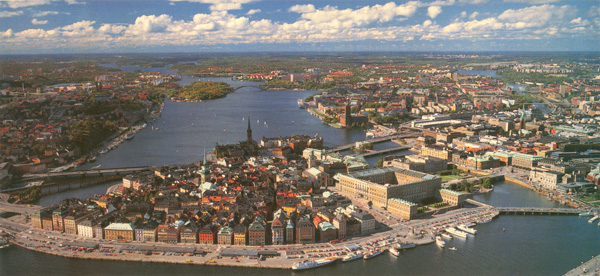
We have reached the town of Ed, the Swedish flag flying atop its station. It is 10:15. The transition from Norway to Sweden has been an easy one, little observable change in landscape or style of habitation. No one has asked to see passports. We look down onto an iceless outdoor hockey rink. Bending around a small lake, we accelerate and move on into a broader, more luxurious domain. It is half past 11:00; we have arrived at Öxnered. According to the schedule we should reach our destination at a minute to 12:00. Alongside us a double highway makes its appearance, author reading its road signs with distances to points in Norway. Looking forward over his shoulder, he glimpses at last an indication that we are heading into Göteborg. As we approach the city an advertisement announces “Pelerins Margarinfabrik.”
At 4:30 pm. In the eighteenth century Gothenburg was headquarters to the Swedish East India Company. Pure blue sky, full sun.A shipping line with exclusive rights to the Eastern trade routes as far as China.Single ideographic cloud behind tall deciduous trees.The present city.Courtyard, Jörgens Vandrarhem, Dalagärde, suburbs of Göteborg. Has a Palm House, a Rosarium and a Butterfly House.
*
Mid-morning stroll down Skånegatan, past three girls distributing leaflets, past guy sporting three-day beard hawking tickets. “Welcome to World Athletic Championships,” says a large sign, sunstruck Ullevi stadium looming ahead. View of crowd through portal: a spectator in yellow visor, shirt already off; the sound of rhythmic applause; the flags of many nations drifting on a rope over the upper deck. As author makes his way around the arena, a world-class walker pumps past in white tee shirt, blue shorts. On the green breeze-ruffled surface of a bordering canal, three green-headed, brown-bodied ducks paddle by, one ruffling its feathers. We have entered Valhallagatan.
We have returned to the city center, past ancient ramparts, to enter Trägårdsföreningen Park, its lawn studiously tended, its walkways graveled. Above massive clumps of trees floats a Fuji blimp in green and silver. At an outdoor café a concert of classical Lieder is in progress, the dark-suited male soloist holding a delicate microphone before his lips. Author, off in search of other attractions, encounters the Palm Garden, in whose window appears a bronze of a young nude, baby in arms. Near the Rosarium he pauses before a languishing fin-de-siècle piece by a Swedish sculptor, as, from the café behind, a female voice enters in duet. At the Butterfly House, through a plastic curtain, he enters the Asiatic section, where, against a background of jungle noises, Europeans clad in white shorts inspect living specimens. A giant butterfly perches atop a tropical plant, fanning its black wings like bellows. Others approach, as though to greet author, suspending themselves in mid-air. Standing attentively under their parents’ tutelage to examine a chart of Chinese types, two boys of eight and ten look up to see a butterfly-like teenage girl, her nails painted blue, examining them.
At the park’s corner we enter the Lagerhuset, an outdoor museum. About a bed of blooming roses four blond girls converge. Along the bank of a canal the garden narrows into a cool path, overarched by the boughs of elms, on whose trunks, high above, bird houses have been attached. In Sweden at every turn something extra is done, for ecology, for convenience, for the quality of life. Author returns to the park’s entrance by way of an open stage covered with a striped tent, its guy wires encased in plywood to protect the insouciant passerby. As a solitary woman prepares a dramatic performance, two boys of three and five sit on the grass before her. We traverse the emerald sward, where a triangular column of mirrored glass reflects it, casting on one side a dark shadow, on the other, the light of the sun.
Exiting the park, author pauses by a circular pool, its rim heavily populated. A fountain within jets to a height of three stories. Two policemen amble past in fantastic paramilitary outfits. Across the busy intersection, atop a black shingled roof, reads the single word ”CLOCK” in yellow-outlined orange, its “O” a dial with hands at twelve and eight. Resuming his progress, author crosses an arch that spans the canal. Ahead, a six-foot-two-inch man in black cut-off top with a single hand on its seat pushes a silver bicycle. Together we reach an heroic equestrian statue, author pausing to take a seat on its pedestal. One step below, a Carlsberg beer open beside him, sits an old salt, smoking, a paper Swedish flag inserted above the bill of his cap. Author arises to continue on down Östra Hamngatan toward the train station; on his left emerge the towers of the Christinakyrka, the Rådhuset between them.
Tomorrow’s tickets purchased, author heads for harbor, up a narrow street untrafficked except for two whores, one in flaming red, the other in bleach-blond hair, who take a seat on a ledge to await his passage. Smiling, he crosses to the opposite side to pass two smiling Africans. As we enter Packhusplatsen, the bow of a ship called “Sea Side” comes into view. Strung across two corbelled windows a bedsheet reads, in red hand-painted letters, “Meat is Murder.” We arrive at a parking garage floating on the water. Across the narrow highway a sign reads “Viking café Viking,” next to it another, “Kinesiska Muren,” followed by the Chinese characters for the Great Wall. We pass a black, high-rigged, steel-hulled ship named “Will,” its decks painted many colors. We walk by a ship all in white that reveals its name only as we reach its stern, where a gold-incised wooden plaque reads “Hamlet.” To our left a tall building, atop it two tall stacks, announces “Göteborg Energi.” In a refitting yard across the harbor stands the Stena Gothica. At the Stena warehouse, surrounded by a barb-wire-topped cyclone fence, a sign reads “Hittegods” [lost property]; another, with a yellow geometrical eye on a black ground, “Argus Wakt.” At the Stena terminal, Danish, Norwegian, Swedish and Finnish flags fly side by side. Three fire trucks race up the avenue, followed by an ambulance.
For above an hour author perambulates a lower-middle-class neighborhood of commercial establishments and housing blocks. A kid clad in black clatters past on a skateboard, his tee shirt reading “Hard Core Drug Free.” At the corner of Nordhemsgatan and Tredje Långgatan sits Le Village, on whose black awnings reads, in gold, “Bar och Antikt.” Across from a neo-gothic police station a sympathetic alcoholic hits up author for three kronor. As author turns into Linnégatan, named for the great Swedish author of the biological system of classification, a sign reads “F” (pink) “I” (yellow) “X” (blue).
The neighborhood gradually turning middle-class, author enters into Friegångsgatan. At the corner of Haganygata and Mellangatan, as he stops to tie his white shoelace, he is propositioned by a black prostitute. The sky has cleared. Outside Robert Dixons Stiftelse sits a brightly polished, red-tanked Harley-Davidson, black fringe on its black bags. The view up this flagstone side-walked, cobblestone road-bedded street – two blocks to a knoll covered with trees – shows only three cars parked in a whole block of grey, cream, ocher, red and yellow buildings. At the corner, outside a dress shop, sits a rack of white dresses.
Author mounts a steep hill into an upper-middle-class neighborhood of plain high-rise apartments and small hotels. The wind picks up, bearing with it Göteborg’s fragrance. Perhaps her lovely, perfumed, sandy-haired, middle-aged women have something to do with it. Circling back toward Götaplatsen, author traverses Amund Grefweg, reaching a triangular corner, where a blue-and-white zebra-striped trolley car mounts the hill side.
Arrived at the plaza, he takes a seat in the shade on the steps of the Konserthuset, across from the Stadsteatern. Between the two, on a cobblestone rise, stands the gigantic statue of Poseidon, his head capped in childishly thick bangs, an archaic smile on his lips. In his hand he holds a fish, out of whose nostrils and mouth gush three streams, as other fountains at his base spray him with water. An awkward blond lad in lavender sweatshirt must pose with his mother before the great god to be photographed by dad. Behind Poseidon rises the art museum. Mounting the limestone steps, author finds its bronze doors, one bearing Athena, the other Apollo, locked. Turning about, he views over Poseidon’s showered back the long esplanade of Kungsports Avenyn, light catching the leaves of its bordering lindens. Below in the plaza fresh-cut lumber is being raised from the bed of a Scania truck. In red sneakers, a lissome eight-year-old girl flips both sides of her long red-flowered skirt. As she swings back and forth, framed by the theater’s two neoclassical caryatids, the wind swirls her blond tresses overhead.
Descending from his post, author skirts eight-year-old and family, the snot-nosed baby bawling, on past a pair of 20-somethings smelling of strong soap. At Engelbrektsgatan, he scurries to cross before a black, inward-veering Volkswagen bug. Ahead, on the side walk, attracting a small crowd, a Swedish band offers a spirited rendition of Dixieland tunes. Two Muslim girls approach and pass, one in a black, one in a cream shawl. A red-haired mother and her gorgeous red-haired daughter, both in black tee shirts, wander into author’s path, he inattentively almost colliding with a 20-year-old beauty whose tee shirt reads “Replay.” At the next intersection a chartreuse-vested policeman, his baby blue jumpsuit silver-striped, holds the waiting pedestrians at bay.
Author takes seat on bench to absorb the parade of dazzling women: black girl in tight mocha knit, her legs emerging from beige socks above short, cream tie-up boots; blond bob-cut girl striding past in a deeply-tanned athletic rhythm; full-breasted strawberry blond, 35, the whites of her eyes showing, as she glances at author; Asian girl in high heels, her ebony carpet of hair sparkling in the sun. Two blond four-year-old twins recline in their pink perambulator, as a pouty French teenager in “Often Imitated, Never Equaled” tee shirt pauses. A gaggle of five pre-teens, the colors of the Swedish flag daubed on their cheekbones, stop to buy bubble gum. Atop her head at a jaunty angle a green “Girls Like Attitude” baseball cap, a tall, dark Israeli beauty glares at author.
We conclude in Kungsportsplatsen, its crevices blackened with shadow, light still ablaze on its upper stories. Surrounded by weary tourists, an eight-member band of Bolivian aborigines performs its seductive rhythms. The wind picks up again, sending curb side detritus skittering, modifying bamboo-fluted, mandolin melodies, overturning the maple’s green leaves to reveal red undersides.
*
The trip from Göteborg to Lund, on an uncrowded early-afternoon train, takes us through ever-widening landscapes, broad enough to accommodate spacious fields of wheat, much of it being harvested – or just having been. The main stops of Varberg and Halmstad are so unimportant as not to be listed in the guide. Only Helsingborg, across from the more famous Danish Helsingør (Shakespeare’s Elsinore), receives comment. We have left the province of Bohuslän to enter that of Skåne (Scania). We rejoin the coast, the Öresund here separating Denmark from the southern tip of Sweden. Without a pause we traverse the town of Landskrona, cartographical center of Europe. At Helsingborg, only 25 miles from Denmark, the train has been decoupled, four of its cars continuing by ferry across the sound, thence to Copenhagen, the remainder on down the coast to Malmö.
Arrived in Lund, author strolls its main street, past Optik Magasinet, Burger King, Gallerix. Along Bytare Gatan a young painter daubs sienna over a lighter ocher, smearing creamy window sills. Otherwise well kept, the little city is friendly, smiling faces tacitly asking “And who might you be?” At the railway station, a beautiful middle-aged married woman has gone out of her way to allay the traveler’s anxiety, booking in advance for him his sleeper from Malmö to Stockholm, writing out by hand the times of tomorrow’s trains.
The late-afternoon sun, though much closer to the horizon than Oslo’s, is still bright. As author circles toward the Domkyrka, Lund’s leading attraction, four male undergraduates pass, smelling of cologne. ”Even if we hate you,” proclaims a graffito, “we won’t kill you . . . YET.” Before long the double pyramidal steeples of the Romanesque style church materialize. Once inside the narthex the odor of wax fills the air, as candles illuminate from within a metal sphere. A gaggle of young Spanish-speaking tourists stands beneath a red electric sign that reads, alternately, “24o” / “17:24.” We continue our stroll through this pleasant if provincial town, past travel agency (in whose window a map of Italy composed of pizza slices, crust for the coastlines); past a charcuterie, vegetables displayed in its windows (tomatoes piled on white plates, green peppers in maroon metal vessels, cucumbers wrapped in plastic, a green bowl of red peppers surrounded by leafy lettuce).
Having started a second circular outing, this one embracing the first, before long we reach a park, a huge elm at its center; under another deciduous tree stands a statue of Carl Linnaeus, deep in thought, as he examines through his magnifying glass a handful of flowers. A little farther and we enter the general precinct of the university, the streets taking on an historical air. Along a high wall a graffito has been scrawled in Hindi, Swedish translation provided beneath it; in a second hand: “Clapton is God.” As a 20-year-old African male in red and black athletic suit labors uphill on his off-road bike, a Swedish girl and her Asian classmate coast downhill, the latter asking, “Should we go to Louise’s room?”
At last author completes his second, much wider circuit, returning to store fronts across from the train station: Parfumerie Nefertiti, Café Fellini, the Da Tong restaurant. At 6:15 the street is already closing down. As an old pigeon-toed codger shuffles toward him, an overweight but active woman in white dress strides down an alley filled with sunshine.
*
Having reached Malmö from Lund late in the morning, author sets out at once on foot along Norra Neptunigatan, turning east to cross the eastern arm of a nearly quadrangular moat that defines the inner city. Arrived at Norra Vallgatan he turns south again, past the hotel Pallas, past the Olympus Restaurant and Pub, its doors open but not yet for business; on past the Hotell Royal, past Liber Hermods, on whose door someone has painted a small graffito reading “Porn.” We have reached Kungsparken. Outside is stationed an orange Superbeetle, within, a Volkswagen bus, on whose side the hand-brushed words “Teater Anonymos.”
Traversing the grounds of the former palace, now museum, author turns corner past greenhouses to face a large black windmill, three stories of windows penetrating its sides, its uncanvassed armatures stilled. Before it sit students listening to their teacher. Crossing Slottsmöllebron, the palace mill bridge, we turn northward again to encounter a family occupied with feeding geese, behind them a sculptural group in bronze: “Pojke med Gäss,” a twelve-year-old boy in bronze with two bronze geese, a third goose at some distance ahead of him. We continue along an asphalt path leading out of the park, past bronze nude reclining in sensuous attitude. We face back to observe boaters on the waterway. A cyclist on the bridge that we have just crossed hovers above the boat. Beneath a tree a sandy-haired girl leans her back against the back of her boyfriend. Two gorgeous blond girls in white tank tops and khaki shorts recline on the grass, their unlaced greige boots removed. Author, pausing under heavy leafage, is joined by a young wedded couple, the husband clasping a new-born babe to his chest. On a tour boat in the adjacent canal, to an audience seated at tables, a guitarist is singing a song of love.
At the park’s exit stands the Stadsbiblioteket. As we reenter the city proper, at the corner of Fersensväg and Regementsgatan, a sign reads, in red, “Malmö,” in black, “Traffikskola.” Author crosses the intersection and heads north. Two workmen are installing a new sign, the sign on the side of their own truck reading, in red, “Spectra,” in black, “Montage.” A white teenage girl in long red hair glances at author, as two squawking gulls circulate above the scene beneath them. “Hermes Tours” reads a sign in Greek-style letters. In the next shop window a large anatomical drawing titled “The Muscular System” displays both front and back views. Author passes a recently closed shop, its floor being sanded in preparation for its next occupant; “Hyper Hyper” reads its sign. Crossing David Halls Gatan, author looks in at a display of Oriental rugs. Next door, in front of a shop called “Xtase,” on a paint-bespattered stepladder sit single shoes, white, grey and turquoise, yellow, beige and pink, one to each step. At the curb a man in white pants, white shirt and white cap holds the strings to three balloons, red, blue and yellow. Up the street a sign reads “Dance Life.” Author turns right into Södra Förstadsgatan to join the stream of midday mall-strollers. On the corner stands a store called “City Livs.” He passes another called “Nya Kina” (New China), entering to discover products manufactured to standards of western taste. An interior design studio called “Housing” has its “i” dotted with a “q.” He passes “Minerva,” her blue letters on a golden ground; having bought a pear-flavored yoghurt, he examines her display of antique bottles.
Emerging from the mall into Ö. Rönneholms Vägen, he faces a triangular shopping center, along one side of which stands the Jin Long Restaurant. A young man walks by in black pants, his red tee shirt outside them, behind him a six-story apartment building with cream trim and a green mansard roof. A middle-aged man walks by in white pants and a black shirt, on it the alphabet stenciled in white. This avenue is cast into shadow by the new Sheraton hotel, its elevator visible as it ascends a glassed-in shaft. A black-roofed yellow Corvette convertible stops before the hotel, its back lights blushing arterial red.
It is 1:00 o’clock. Describing a half-circular course, author arrives at Gustav Adolfs Torget, one of the moated city’s two largest plazas, where two short-shorted blondes are distributing lavender balloons, at their feet a red heart-shaped pillow reading “I Love You.” We pass into Södra Gatan, whose architecture mixes old and new. Flying above the street are banners in black, orange and yellow. Author descends into Stor Torget. Viking herms support the pilasters of an eight-story sandstone building. Above a theater, its sign reading “Camera,” another reads “Turnus.” Higher still appears the planet Saturn, represented as a silver half sphere, neon lines forming its famous rings. To the north-west rises the steeple of the central railway station.
It is 2:00 o’clock, author strolling along the shady eastern side of the square. At the base of its six-story buildings are cornerstones recording their dates of construction: “1904,” reads one. At the end of the way stands a café called “Piccolo Mondo.” This square opens into another square, the Lilla Torg. The sun shines warmly on a geranium planter and a muscle-shirted six-foot-four-inch Swedish man promenading past it. By way of Johansgatan author exits to continue north along Norra Vallgatan. Across from the train station a huge red crane based in a blue truck is lifting a refuse bin, two feet by four feet by ten feet, through an open window on the sixth floor. A statue of the city founder, Franz Suell (1744-1870), looks down the narrow shaft of the inner harbor toward a lighthouse, framed within a crane’s three-sided armature. Across from him on the side walk a bride and groom pause to be photographed. Author crosses Franz Suellsgatan and continues northward. At Prostgatan he encounters a building in three different values of grey. “Diligentia” reads its motto. A young woman drives by in a white coupe, two young sons strapped into the seat behind her. The side walk before the Hotell Norrvalla is nearly deserted. Half-filled buses pass. Across the canal a train arrives, behind it three tall pale green grain elevators. Another train exits the city heading north. Author crosses the narrow Bagersgatan, looking down corner steps into a café named “Oasen.” Over its entrance, spray-painted in blue, is the single word “ding.” In front of a yellow stucco building are parked three red cars in almost matching hues.
We have reached the eastern arm of the ring canal and proceed along the Västra Promenaden. At the corner of Tullgatan a long sign reads “System-Texte.” It is a store that sells signs. One reads “Hängende Last”; within its black triangular frame, on a yellow ground, is depicted a large rectangular box, one of whose supporting cords has just broken. We cross the northern arm of inlet water and enter into Östra Förstadsgatan. Across the way stands a shop named “Census Data,” another, “Star Light Hair Salon.” Two twelve-year-old girls, one black, one white, stroll along lank-limbed, smiling. We pass by Asian Express, across from it Nanjing Da Fan Dian, to enter Aladdin. Almost hidden by oriental fabrics, perched upon carpets at a small work station, the owner tamps at an object, alternately peeking at and ignoring author. His store is filled with treasures from the East: elephants, ships, large-breasted Indian goddesses; flasks, scales and beaten vessels; scarves, beads and tiles with Arabic inscriptions; lutes, castanets and other musical instruments. Author approaches to admire his artful reassembly of a silver tabla.
A studio called “Polyphoto” is filled with wedding pictures: a demure bride smiling but uncertain, her floral bouquet in yellow and blue already beginning to wilt; a slightly older couple in street clothes, her bouquet held beneath her hip; a sailor with two bright-faced girls, all three figures in sailor hats. A heavily-perfumed middle-aged woman passes, tanned, her ankle-length dress fitted with many buttons up the front, nowhere near all buttoned. A six-foot-three-inch guy in running shorts and dark glasses pauses to light a cigarette, his shirt vertically striped in red, blue, orange, purple and black. Reading the paper in a doorway, a grey-haired man in a yellow tie sits on an overturned clay pot, a tall can of Coke on the stone doorstep beside him. In a Phillips store, beneath florescent lights and circulating fans, household appliances are displayed. On the closed door of an icebox a photograph of its contents has been pasted: a bottle of wine; a bowl of eggs; salami; a newly-baked cake; a shelf of beers, another of soft drinks; a fresh fish on paper, dried fish in a dish; olives, olive oil and caviar; cups of yoghurt; mushrooms, radishes and string beans; a large tomato; a can of Delmonte fruit cocktail; strawberries, plums and a pineapple; oranges, lemons and limes. On the corner is a record store called “The Jukebox”; inside, wearing a black tee shirt, a youth is examining CDs.” If you don’t love me,” read the white letters on his back, “I’ll kill myself.”
We have reached Värnhems Torget. As Föreningsgatan leads out of it, a red-headed girl in a purple velvet to-mid-calf dress strides past, two bare-waisted guys, one with a purple heart tattoo, following. Having received no response, they stop to buy soft drinks and hot dogs. Farther down the street a sign reads “ABC Rehab”; beneath the A, B and C neatly-lettered graffiti read “Anna,” “Boris,” “Carina.” At the next corner a service advertises “Securitas,” its offices taking up the whole first story of a block-long building. The lower-middle-class neighborhood now grows progressively lower-class, apartment blocks devolving into plain brick, grey stucco. Two little black kids cavort on the side walk. An eight-year-old girl in dredknots shows her biceps to her seven-year-old brother, he squeezing it, she laughing. Author detours into Zenithgatan, where nineteenth-century sweatshops line one side of the street, opposite them factory dormitories. In one of the grimiest windows, a graffito in yellow reads “SUN.” On the wall of the next building in white paint the “A” of anarchy has been drawn and circled. Two middle-aged men cycle by with their shirts off.
Author rejoins the more affluent Föreningsgatan. We have reached the corner
of Exercis Gatan, where the three blue awnings of a racquet shop read:
“Badminton,” “Squash,” “Tennis.” The sun still high at 3:00 pm, we skirt the
black-railed Mosaisk Begravningsplatsen, a Jewish
cemetery, either side of
its allée bordered with tall leafy trees. A mother in black dress pushes a
white baby carriage across the zebra stripes of the intersection. Together we
enter St. Pauli Kyrkogatan, headed for the edifice itself, its towers, turrets
and steeples in pastel blue, all surmounted by a curlicued open-work cross. At
the foot of this truly ugly yellow brick church strolls a mother with two young
daughters in lavender and purple. On unicycles two more kids, one white, one
black, pass behind a green Volkswagen bug. Author continues southward on
Kungsgatan, treading the cinder path of its allée, moving in and out of the
sunlight past luxuriant beds of semi-tended flowers. At last he arrives at a
circle, at whose center stands a bronze neoclassic Flora, her left arm raised
above her head. Reclining on one of four surrounding benches, he falls
asleep.
After an hour’s nap he arises to cross a broad avenue, where the window of Scandorama gives back his reflection. We have joined the southern arm of the canal, on which preparations for a dragon boat race are under way, the three crews dressed in yellow, baby blue and black. Two young men holding pikes stand by the boats, ready to push them off. Aboard each a drummer is testing his drum. Having crossed the bridge, author descends to the landing for a closer look at the crews. Strutting black-shirted oarsmen are attaching masks of faces to the backs of their heads, propeller beanies atop them; the yellow-shirted contestants are arranging flowers in their hair; the blue-shirted crew is donning ridiculously long billed caps. As spectators gather, the oarsmen take their seats; pushed off from the moorings, they begin to paddle slowly toward the starting line, one bridge distant. In the stands kids jostle for position, as a Swedish announcer amuses all with his loud, enthusiastic comments. A single yellow balloon floats on the green surface of the water.
As the three boats – Norwegian, Swedish and Finnish – line up for the race, another balloon, cut loose, drifts high over the foliage; become but a red dot, it disappears into the deep blue vault. Slowly the boats approach, their order from here indiscernible. The crowd, at first indifferent, begins to cheer but is quickly distracted by other matters. Someone has been tossed into the canal from the landing. The announcer keeps up his patter, making many jokes, to which the crowd sporadically responds. Almost as an afterthought the race continues. Before long the boats straggle past the reviewing stand, to a scattering of applause and jeers.
Race over –the Finns having won handily, the Norwegians a distant third – author continues on up Amiralsgatan, crossing Södra Promenaden. At the intersection a shop sign reads “Go On: Data Butiken.” It is 17:14, 26o. Two long-legged girls in miniskirts, one blond, one brunette, jaywalk across the street, stopping traffic. A silver-striped lavender number 100 bus resumes its progress. At Baltzarsgatan author turns westward, a resplendent red-haired 30-something in black skirt and russet jacket looking him over as she sidles past. A blue Volkswagen bug scoots by, Mickey Mouse tied about its rear view mirror. At Kalendegatan we arrive at “Eviva,” whose sign reads “Underkläder / Strumpor,” underwear / stockings. In shorts and dark glasses a resigned, 28-year-old guy awaits his wife, his hands on the bar of a baby stroller. Up the street some distance musicians are taking warm-up licks. All in black pants and black shirts, they seem to be another group of Bolivian Indians. We pass them and rejoin Södergatan, heading again toward the Stor Torget. At Skomakaregatan we encounter yet another group of Indians, wired for sound, hard into their melancholy riff.
We have returned to the Rådhuset, before which a giant stage covered in black cloth has been set up for more music. Above it red letters read “FEST.” The city hall provides the backdrop, its black-streaked red sandstone still sunstruck at 5:30. Atop the clock tower sits a golden scale, judiciously balanced; higher up, catching the brilliant light, a copper wind meter in the form of a double ax; at the pinnacle, a scythe, added for extra good measure. In the interval since early afternoon the whole plaza has been furnished with long tables, covered in white paper, on which have been laid out plates of crayfish, bowls of potato salad, pitchers of beer. By each row stands a company placard. Middle-aged employees sit in the sun to enjoy an easy conviviality. Gradually the level of activity increases, a band starting up, vocalists adding at loud volume the sentimental strains of popular Swedish songs. Once into their cups, the sea of humanity sways to the music, dancing together in pairs and foursomes.
As the sun begins to decline behind its tall buildings, author departs Stor Torget, taking a street that leads toward the station, past a tent where a rock band chants the refrain “I love you.” Norravallgatan has changed its aspect, as author crosses it amidst a lively, tipsy crowd on the move to another musical venue. Having at last, in front of the station, completed a day-long figure eight, and having confirmed information regarding late evening departure for Stockholm, author sets out up Skeppsbron for serious outer harbor investigation.
Within two blocks the streets of this shipping zone are vacant. It is 7:30, the immaculate pavement still warm. We are quickly approaching a view of the Öresund. At the dock’s end we come upon a sign reading “Malmö City International.” As we round the corner, a bulky freighter, the Nordö Link, emerges into view. Atop its deck four trailer-trucks are transferring their cargo to the ship’s hold. In the next berth is moored the Swedish-German Malmö Travemünde. Through a crook in the levees that separate outer harbor from open sea there now appears a grey speck of a ship, as it wends its way into the harbor. Leaving behind this modern dock, we come to another, reading “Malmö Świnoughście,” a Polish sailor exiting its terminal. Facing back toward the inner city, as we stroll onward, the pale green grain elevators, the towers of St. Pauli, the hotels along the quay all disappear behind the tall curtain-wall headquarters of a shipping establishment, its top story faced with a web-like half circle of glass. Much along this dock side has been modernized, though, as we turn again toward the inner harbor, the names of side streets recall an earlier age: Tellus, Venus, Mercury, Mars. On the southern side of Carlsgatan late model Japanese cars are parked against a backdrop of traditional masonry, its red brick courses divided by black-tile-bordered white stone.
As author rounds the third face of the imposing Slagthuset, a little airplane with a banner advertising the festival continues its circuit of Malmö. Turning westward, we face a magnificent building to the north of the station, its domed cupolas sheathed in green-corroded copper, its loading docks bearing the post and telecommunications logo. Arrived at Centralstation, across from which, in light cream outlined with white pilasters, sits the Börshus, we turn once more to perambulate the crowded eastern bank of the inner harbor. Crossing Suellsbron, we enter into Hjalmare Kajen, along whose margin several ships are moored. It is 8:00 o’clock. Armed sailors guard the Malmö gang-plank, as, on deck, three black-clad blond girls party with officers. Farther along, before the Göteborg, a single military policeman stands at attention. In an open space to the left of the ships, a folk band swells the ambiance with nostalgic songs, oblivious revelers milling about.
Author veers westward, following the contour of the outer harbor. The little speck of a ship has emerged as a freighter gliding past the light house on its way into port. Completing a new wharf, a three-sided, eight-story crane frames a warehouse labeled “Intentia.” Looking back eastward through the armatures of a little white bridge, we glimpse another grain elevator; standing against a cerulean sky, its face seems powdered cream and rouge. A tiny bird flutters through the frame and out again, diving into a pale grey horizon. It is 8:30, the sun fallen behind Kockums Submarine Systems, whose curved front is composed of reflective light blue windows against bands of darker blue. As we stroll past it, the Convention Center, still under construction, comes into view. Having traversed the long arc of Stora Varvsgatan, central avenue of a new industrial park, we enter a basin bordered with little wooden houses, counters set up in front of them for fisher-residents to distribute their catch. At this festive moment all is deserted, counters and houses alike. Doubling back from the harbor into Citadellsvägen, we confront the monumental Malmöhus, at either corner of which obtrude vast circular towers. As dusk settles, in a lot across from the citadel sits a silver Volkswagen bus of ancient vintage, hand-painted on its side in black, “We are on a Mission,” across its front, in green, “No Problema.”
*
Lodged in the more economical suburbs, author takes early-morning metro for Stockholm center, observing row on row of grey stucco apartment blocks, eight stories tall, on the side walks below them neither speck of dirt nor sign of life. Station steps, embankment, crosswalk have all been covered with graffiti in registration of a generational discontent with the social welfare dream. At water side things begin to pick up, the descended train resurfacing into the light of day. We are passing over the surface of Stadsholmen, the triangular island that houses Gamla Stan, the old town, to cross into Norrmalm, or Stockholm proper.
Arrived near the central station, one exits into a square dominated on the lower level by the Stadsteater, on the upper by the Kulturhuset. At the center of its traffic circle arises from a pool a 60-foot-high abstract glass sculpture, the rest of the space controlled by modern banks in curtain-wall construction. “Photo Quick,” reads a shop sign in white; “Bookman,” a second in red; “Persona,” a third in black. Author turns to head up Sveavägen, where office buildings on the left of the broad avenue have been arranged like enormous bookcases jutting out over its broad side walks. As we cross Kungsgatan, these modern slabs give way to seven-story stucco mansard-roofed edifices. Off to the right, in the shade, a semicircular arch connecting two neo-classical towers covers a side street. At Tunnelgatan one glimpses stairways rising in ranks to a much older building, its turret topped with a cupola, mounted by a spire. A middle-aged man in a thin-striped blue-and-white shirt, cigarette in hand, is walking a large dog. It is Sunday morning. We are traversing the length of a shallow valley between two hills. To the left, over the hilltop, one glimpses the upper reaches of a crane at harbor side. Tall stucco buildings continue to line each side of the avenue. On the ground floor of one, in the window of an art gallery, is displayed a revised Michelangelo creation scene: Adam, holding an Oscar, film covering his genitals, receives the spark of life from Marilyn Monroe as God, her fingertip about to touch his. Surrounding her is a chorus of angels: Clark Gable, James Dean, John Wayne, Elvis Presley. “Olympia, Men’s Fashions” says a sign upstreet, in reference to an earlier pantheon.
At Kungstensgatan we pass a travel agency called “Apollo” and continue on past Swedish Clothes, past Indian Cuisine, past a bookstore showing an ancient map of Italia Antiqua, beneath which The Scandal of Ulysses, a Swedish Werldsliteraturens, James Michener’s USA. Across the street, at the base of an orange stucco block surmounted by an immense turret, read the golden arches of McDonald’s, repeated many times. At the corner of Odengatan, between American and British flags, stands the entrance to Hard Rock Café. On this side of the street, just out of reach, hangs the Apple Computer apple in horizontal rainbow stripes, a bite taken out of it. “Lap Power” reads the new motto. It is 11:28, 22o. On the opposite side a whole city block is composed of three stucco structures: the first in dark grey, the second in grey-maroon, the third in dirty salmon.
Having arrived at Frejgatan, we turn right, passing a miniaturized Volkswagen convertible bug in baby blue for sale in an auto showroom. As the street rises, a park on its left rises even faster, within it a church, the crucified Christ in stone on its front. At the next corner looms a dark yellow apartment building with light yellow balconies, two of them sporting white-and-yellow umbrellas. We have reached Tulegatan and mount higher to look back down over sun-reflecting parked automobiles. At the next intersection pedestrians are crossing; above them rise the spires of a church. “Copiering Copiering Copiering” read the yellow, blue, yellow words in a copy shop window; inside, a central supporting pillar has been painted red. At the corner of Roslagsgatan a flower store is opening its doors. Three sunflowers sit by its step in a white plastic vase. An orange sign advertises “Solrosor,” the first “o” embellished with rays.
We have entered a block of older ocher buildings with classicizing features. A seven-year-old blond girl dances in front of a car from which her mother is exiting. At Birger Jarlsgatan a sign reads “Balkan Holidays.” At Valhallavägen author begins a gentle ascent of a grey side walk bordered in grey stone buildings. Through an aperture on the right arise two grey smokestacks. We pass Europaklinik, the word “Vaccination” in its window. At Odengatan we turn back at an angle less than 90o. Outside the Latvian Embassy, a six-year-old Asian girl studies an advertisement in Swedish for The Lion King, the Disney movie. We turn into Bragavägen, where cottonwoods shade a square surrounded by brick residences. At Östermalmsgatan we descend again. Ahead of a red bus, a 35-year-old stroller, in white tee shirt and khaki shorts, is pulled across the street at a racing pace by his large hound. At the corner of Rödmansgatan a clock, rotating on its vertical axis, reads a minute to 12. We pass Hair Explosion, Café OK, Wow Aerobics, entering into a broad plaza filled with ugly black sculpture, thence into Runebergsgatan with its handsome red-brick mansions. On the wall between two fashionable shops a graffito reads “Loser.”
Author enters into Kungliga Humlegården, the largest park in central Stockholm. Its ample spaces heavily shaded by tall elms, the park is sparsely populated: a promenader here and there; young couples sunbathing; two girls coasting down a slope on their bikes. Trailing a middle-aged woman in a yellow flowered dress, author descends a cinder walkway past a skateboard ramp to a circular plot, inset with flower beds and surrounded by benches. Reading against a blue sky is the towering bronze statue of the elder Linnaeus. Two seated bronze votive figures at its base have been offered black exercise shoes, one filled with pink and yellow flowers. On a dark green bench, in white, a graffito reads “Peach.”
We exit into Sturegatan to climb back up to Karlavägen, skirting The Blue Bar, its paraphernalia painted blue, the Galerie Blanche, its watercolors in black and white, to arrive at “ME,” a sign at the corner of Kommendörsgatan. We pass Bio Kosmetik, Spectra Physics, Galerie Linnaeus, in whose window sits a single volume entitled Svensk Dikt. Across the street, leaning against the park’s railing, four young people wait for a bus in the sun. Author turns into Karlavägen, a broad, high class avenue with an esplanade running down its middle, and heads toward the harbor again, past shops called “High Fidelity,” “Piano,” ”Mondi.” A red-haired girl in black pants and white boots stands beside her bike, as she takes bills from an automatic teller machine. Author purchases an International Herald Tribune. A black pickup truck crosses Karlavägen and heads into Sibyllegatan. We continue up the avenue, past the striped awnings of Thalia, the green-on-white sign of Persienn Gruppen, maker of window blinds, the flowered display case of Marias Håvård. We pass Karla Frukt, an expensive fruit, cookie and candy store; in its window display: Spanish gallia melons, Portuguese kiwis, French pralinés blancs, Danish apricos-marmelad, English cheddarettes.
Arriving at the Karlaplan, author descends to a circular pool centered on a white jet. A single bell tolls 12:30. Taking a seat on one of two benches filled with old people, he scans the headlines: “First Humans in Europe”; “Election Fever”; “China Pours Cold Water on Hong Kong.” An attractive blond mother with her blond eleven-year-old daughter, the latter gesturing animatedly, stroll by. At the shallow pool’s rim is parked a blue baby carriage, silver bell and white steering wheel at its front, a camera at its back. Baby’s shoes and mother’s sandals sit on the pavement beside it. Attached to the carriage’s chassis is an orange balloon. Some distance off mother and baby wade in the water. As a fire truck careens by, three children, aged two, three and eight, strip naked to bathe, their pregnant mother supervising them. Now the father, in salmon shirt and blue shorts, materializes, stepping into the pool with them.
Author exits Karlaplan into Narvavägen, where a girl, one hand on a doorknob, is kissing her boyfriend. A girl in a black jacket and black helmet descends on a black moped. Author crosses from shady side of avenue to enter the brightly lit cobblestone forecourt of the Historiskamuseet. Across the way a tall Swede walks by in a tee shirt reading “Get Fat.” Joining a wave of promenaders, we take a bridge over the Djurgårdsbrunnsviken to Skansen.
Having arrived on the island, we leave behind on our right the
Nordiskamuseet. Bicyclists descend a narrow pathway past sunbathers, rock music
blaring from loudspeakers. Mounting higher, we enter this outdoor museum of
historically reconstructed buildings. We visit a
seventeenth-century
farmstead complete with cow barn, hay barn, pig pen; stable, kiln and grinding
shed; storehouse, smithy, children’s playhouse. All is constructed of enormous
blackened logs. In the main house we visit a gloomy dining room, dishes set on
an unbelievably thick wooden table, its benches much too large for normal-sized
people. In the bedroom, socks suitable for giants hang over the fireless
fireplace. Leaving the farm behind, we approach the eighteenth-century Seglora
Church, moved here from southern Västergötland. We stoop under the whitewashed
arch of a low stone wall to be stared at by black and white geese sitting in
its courtyard. The dark narthex is filled with neatly stacked maroon psalm
books and black hymnals. From the outside the shingled church has more appeal,
but not much. Moving on, we visit a nineteenth-century laborer’s cottage, its
cheerful guide arguing against the cramped gloom of its interior.
As we exit Skansen, over its entranceway the clock is stuck at 12:00.
Author passes from the northern part of Stockholm over a small bridge to Gamla Stan, the Sveriges Riksdag just visible on the right through massive trees that mask it. On the left we leave behind the Medeltidsmuseum, the museum of medieval antiquities. The entire island is bathed in a luxurious soup of off-key popular festival schmaltz. We turn a corner and peer into the three-sided outer court of the Kungliga Slottet. Under a large bronze of King Gustav III, who imported high French culture into Sweden, two Americans dressed in Superman suits sing, very loudly and very badly, for a middle-aged, middle-class crowd, renditions of songs now 30 years out of date. Ahead, across an inlet that separates Gamla Stan from Södermalm, atop its ramparts, rise the cream stucco walls, brown dome and gold cross of the Sophiakyrka.
As author strolls the shady side of Skeppsbron, the wind picks up, creating a ballet among beachball-sized balloons tethered above a restaurant, triangular advertising pennons flapping so furiously that their legends are not legible. Among pedestrians bent against it the wind flips up blond hair, races through skirts, flaps shirt tails, cooling the sunny scene, as author exits the confines of the narrow-alley-bordered avenue into the broader harbor, preparatory to passage across to Södermalm. The wind dies down.
Having mounted the promontory of the island’s northern shore, we face backward for a view into the Saltsjön’s azure waters, for a view across the yellow, rust-red, ocher buildings of the Gamla Stan. It is 28o. Farther up the hill, past a tunnel’s aperture, the ambiance becomes much starker; unadorned by signs, entrances to large hotels and restaurants suddenly present themselves. As a low retaining wall opens out alongside the little-trafficked Katarinavägen, we look down a hundred meters into Stadsgårdsleden, the harbor side drive, where a single file of sedans snakes past like a chain of DNA. We look down too upon an orange-hulled ship, a heliport at its prow. Facing it is a blue-hulled tanker.
Opting for more direct access to the life of Södermalm, author turns southward into Renstiernas Gata, where a classic Nordic scene emerges: a street converging in perspective, its building fronts rising from massive granite outcrop in beige, salmon, and yellow brick, all bathed in the lachrymose sunlight. The arena darkens. We have come upon a dress shop called “PLUTO,” its letters reading downwards. Within a hundred yards we come upon a restaurant called “DIONYSUS,” its tables set out on the sunny side of the street.
At Ringvägen, as we turn right, a white-striped bus approaches from the opposite direction. Along this tree-lined boulevard every corner has its café: couples sitting over beers; an older man alone; a young mother and her baby, standing up in its carriage, its face smeared with ice cream. Turning north into Götagatan, we enter a middle-class district of lively economic enterprise. A guy in a black jacket, black tee shirt, red pants lights a cigarette and hustles across the broad avenue, dodging traffic. It is 17:15, 25o. As it narrows and begins to ascend a hill into an upper-middle-class neighborhood, we continue on up Götagatan, cresting a rise lined with guitar and piano stores, where we begin our descent once more, Norrmalm visible over Stadsholmen. At Hornsgatan author turns left, heading directly into the setting sun. As he crosses to the northern side of the street to observe its southern façades, a beautiful girl, also crossing the street, observes him. Author in turn observes her, as the sun’s deep rays penetrate her dress, accentuating the motion of her long legs.
At restaurants along the way sit overweight Swedes eating full meals at half past five. A woman on her way to the supermarket pulls a wagon, her two blond children seated in it facing sideways. In the window of a second-story apartment a globe represents the world. Author takes a table at a small café, his back to the late rays of the sun. As they approach him, facing into the light, local denizens must squint, author studying them at his leisure. Next door, on the sign of an ice cream shop, a blond angel bears four cones: red, blue, yellow, brown. Another beautiful girl sidles by. From beside the curb a black car pulls out to join the flow of traffic, leaving behind three red cars parked ahead of it. A middle-aged man in grey hair, grey shirt, grey pants, crosses the street, gets in a four-door red sedan and drives off.
*
Having arrived at Luleå, on the coast of the uppermost reaches of the Baltic Sea, author pauses along its harbor to gaze out over the water. A town of 70,000, Luleå was founded in 1621. His overnight train has reached this small, metallurgical center at 8:08 in the morning, on the third of a three-stage journey from Stockholm. Aside from the municipal government, which employs 6200 people, Swedish Steel employs the most, at 2600. To the south military jets take off from the Luleå Flygstation, skimming across the horizon. It is a municipality with a low average age. The town has all the signs of prosperity observable elsewhere in Sweden. Individual income, however, is higher than the national average. To cross the harbor road one takes an escalator up to an overpass, all enclosed in a glass gallery against the winter wind and snow. The harbor side mall is bright with modern appurtenances: new cobblestone walkway, pretty flower pots, clear globed lamps, aluminum benches. The city is able to offer child care to all families who need it. Behind rise new apartment buildings, each in a different pastel hue, each with nautical elements in its design: porthole-shaped windows, a balcony in the form of a captain’s deck facing the harbor. Its twelve libraries have a book stock of 513,000. Author, at 8:30 the only stroller on the walkway, is joined by a jogger in white exercise suit and black headband. From its airport, the fourth largest in Sweden, direct flights leave for Murmansk and Archangelsk. Two more fighter planes take off in the background. The surface of the water is grey.
We head for the industrial side of the harbor, skirting a marina filled with small pleasure boats; “Matahari,” reads the name of one, “Cassandra,” another. We are passing a lumber yard, a spur off the railway line feeding into it. At 9:00 o’clock on the dot a driver dismounts from his Timberrail truck to report in with a bill of lading. In long yellow hair and silver earring, he wears yellow-striped red overalls. We follow a deserted railway spur to the point where it joins the main track. A single gull caws and flaps out over the harbor. A man cycles past in cap, grey jacket and round glasses, through which he peers at author, who, with his 40-pound backpack, must seem something of an oddity. Seeking a place to stow his burden before setting out farther (it has also begun to sprinkle), author turns back toward station. Beside the tracks, complementing the rust-red of the rail cars, grow slender stalks with magenta wild flowers atop them. From beyond the station arrives a yellow track-sweeper, its plow lifted high in the air. It begins to churn the dirt between cross-ties, coughing up a steady billow of ocher dust. Taking the overpass, a white truck crosses the tracks. Higher still another military jet veers over the rail yards. Station in sight, author pauses at its outskirts to take advantage of a free bench. Divested of backpack, he sits to summarize his conversation with compartment mate on the last leg of his recent trip. He speaks into his black, hand-held recorder.
This young Swede, twenty-six years old, has taken a break between high school and college to do his compulsory military service – he is an officer – and to travel. He has been to India, Nepal, Bangladesh. He has spent three weeks in Egypt. He has traveled to Eastern Europe with a large group of youthful tourists in three pink buses filled with beds, “twenty-four inside and more on top.” With a stolid, straightforward sense of himself, he is charmingly direct. “There are more important things than making money,” he says, citing the example of his grandfather. At 84 years old the elder man lives by a lake alone, without toilet or running water. Every day he gets up, washes his face and confronts nature. “Modern life is too impersonal,” says the grandson, who is about to begin a course in civil engineering. Hesitating before author’s tale of the inevitable computerization of industry and commerce, he comments critically: “People will be put out of work by this. Though,” he adds reflectively, “other jobs will be created.” With a sense of appropriate modesty, coming as he does from a country that has not sacrificed many lives for world peace, he promotes the philosophy of pacifism. Likewise, with certain misgivings, he supports the system of socialism. “High taxes for good benefits,” he says in summary. His own college education will be paid for by the state. Though he could have attended the university in Göteborg or another urban center, he has chosen to study in Luleå. A cross-country skier, he wants “a real winter.”
As author speaks, a train with three engines enters the station, two white, one black. They are pulling a long line of ore cars, three dozen and still counting. From the sound of the cars they would seem to be empty. Perhaps the train is heading back to Kiruna. Beyond these tracks, arched over others, stands a yellow crane. Caution lights line the outgoing track. Back in the direction from which the ore-train has come, a blue engine has stopped on a siding, its red tail lights shining against the soft grey-green background of fir trees. A gull cries against the stillness. Having left his pack in a station locker, author turns into the town, crossing Florakullen, a small park, through which he traces a curved path bordered with beds of fragrant flowers in red, yellow and blue. Behind them, on a knoll topped with low conifers, stands a canted bronze statue of a nude girl holding a volleyball. Exiting into Hermelinsgatan, we turn left into Storgatan. Within a block this Main Street has become a mall.
Having arranged for a personal tour of Svenska Stål with the help of Anna, a gracious, imaginative 20-year-old girl at the tourist office, author returns to Storgatan, where he takes a seat in a fast-food restaurant to review the copious output of local chamber of commerce literature. Atop the milk shake maker sits a brown bear in brown dark glasses. A pre-noon crowd, entering one by one, places its orders with behind-counter waitresses in uniformly white shirts, red skirts and blond hair. Listed under “Dagens Lunch,” on a small whiteboard lettered in black magic marker, is the special, “Chickymål,” a popular offering. Author decides to partake himself.
Lunch finished, he promenades the mall. A chess game is in progress on a giant side walk board, its tiles eighteen inches square. Today’s competitors are both middle-aged: one balding, in gold-rimmed glasses, the other bearded, in maroon athletic suit. The eighteen-inch-tall metal pieces have been painted black and white. It is cool, increasingly overcast and now windy. Observers, huddled on benches, line two sides of the board. Few of the town’s denizens have yet adapted their dress to the new weather conditions. A girl walks by shivering in bare midriff. Teenies pass in sailor’s jackets and shorts. Above the scene, strung from one side of the street to the other, dirty, tattered Swedish flags flutter.
We are entering the precincts of Svenska Stål with Mats Widgren, a guide from the company’s educational division, who has come to town in a van to escort author. Stopping at the gate to pick up an extra helmet, we proceed the length of the plant to the beginning of the steel-making process, past blast furnace, rolling mill, coke-oven, past a huge stockpile of coal, on to the mooring for freighters. Ahead of us now, on a wide avenue that separates steel mill from finishing plants, is a huge yellow truck bearing slag. Quickly we approach a long conveyor belt transporting coal from the wharf side to a large aluminum-sheathed building. In the coke-oven plant coal is converted to coke. “The white cloud billowing behind it,” our guide tells us, “is the smoke from the coke-making process.” When the resulting gas has been collected and purified, it is used as fuel for the blast furnaces, for the steel works, and for the coke-oven plant itself. Author tells guide that his father worked for U.S. Steel.
We have arrived at Svenska Stål’s private dock, situated at the mill’s extremity, on an inlet off the Gulf of Bothnia. Thus the coke-oven is both an energy and a chemical plant. Ahead of us stands the black-hulled Concar Victory; two green cranes are unloading its black cargo. Coal that is brought in by ship must arrive before December, for after that date the iced-over waters of the northern Baltic Sea are impassible. “Where is this coal coming from?” asks author. “Australia and North America,” the guide responds. The coal is then transported to the vast stock. Turning to retrace our route, we pass the coal stockpile. This area comprises about twenty acres (twelve football fields). A gigantic blue crane with projecting arm is working to increase the height of the already high bed. It contains 600,000 tons of coal. Meanwhile, a yellow two-story earthmover systematically packs the surface. This constitutes 60% of the plant’s annual consumption. “Now the coal,” says our guide, “is transported into a buffer, which mixes seven different varieties.” Coal is charged into the ovens from the top. “From there it travels by means of another conveyor belt to a filling wagon.” The walls of the ovens have a constant temperature of about1300oC. “There it is distributed into 54 different ovens.” After eighteen hours, when the charge has reached 1050-1100oC, the carbonization is finished and the oven can be “pushed” (i. e. emptied).
We have arrived at the parking lot in front of the ovens, where red hot coke is about to be “pushed” into a cooling wagon. When coal is heated in a closed chamber, volatile matter is distilled from it in the form of gases, and the coal becomes coke. Fuming, it empties forth from a holder half a meter wide, seven meters tall, dropping like volcanic magma into the wagon. It is then used as a reducing agent in the blast furnace. Red, yellow, hot; “more than 1000o,” our guide comments. Black smoke and flames swirl off its surface, as the cooling wagon moves along the track to accommodate the rush of burning cakes. After carbonization has been completed, the doors at both ends of the oven are opened, and incandescent coke is pushed out into a quenching car. “Twenty-seven tons,” our guide remarks, “have just come out of one oven.” The event concludes with a tremendous conflagration. From there the coke is transferred quickly to a quenching tower. Black smoke billows up against the sides of the oven, on up through the tracks of the distributing train above. There it is cooled with 50 cubic meters of water. At the end of the car where it has fallen, the coke is still flaming. “The cab of the train,” says the guide, “is operated from a distant station.”
To keep the temperature in the battery constant, one oven at a time is pushed according to a schedule at intervals of five, e.g. Oven 1, Oven 6, etc. The water has hit the coke and is flooding out in steam, madly billowing: white, grey, darker grey. It fills the entire arena between two smoke stacks and the black tower from which the water has been dropped. Next the coke is brought back to a cooling ramp of heat resistant tiles, from which it falls to a conveyor belt. We look down over the edge to observe, 25 or 30 feet below us, the belt onto which it soon will fall.
The yellow cab is now returning with its three-bayed conveyor truck of water-cooled coke. The crude gas formed during carbonization passes through a gas purifying plant, where a number of by-products are recovered, among them coal tar. Having come to rest within 60 feet of author, the truck’s bays open, dumping this awesome load. The coal tar is further refined to asphalt and perfume. In a slow, thundering rush the coke slides down the ramp, tumbling onto a segmented metal belt far below. Crude benzene, another by-product, is used in making plastics and various solvents. The dumping has been interrupted. “The conveyor belt,” explains our guide, “is full; the rest will be dropped in a moment.” Smoke covers the entire parking lot, drifting onto the van, into author’s hair, up his nostrils.
We return to the steel-making zone, to its furnaces and rolling mills. The liquid steel is continuously cast through a funnel-like mold. Having parked our van, we cross the street to enter a ten-story building sheathed in steel corrugation. The strand formed in the mold is cooled and solidified, then cut to the lengths ordered. We have retreated through the grounds but have nonetheless advanced several steps in the production sequence to enter the continuous casting mill. Penetrating yellow lights glare at us from many floors above. We mount steps from the first to the second floor and look down into a casting bed. On the opposite side of the aisle we look down again to witness a red-hot steel slab emerging on the rollers. Mounting again from second to third, from third to fourth floors, we exit the stairwell opposite a control room that oversees the whole process from smelting to the finished slab of steel.
In the blast furnaces ore (in the form of pellets) is converted into hot metal; the limestone and BOF slag provide the correct slag composition. Through the window of the control room we can make out, in addition to a bank of computers, two live attendants supervising the casting that is taking place some 50 feet away. Ore, coke, BOF slag, briquettes of in-plant fines and limestone are supplied continuously to the top of the blast furnace. “On its way between ladle and mold the steel must not come into contact with oxygen,” our guide explains. “This would cause its quality to deteriorate.” On a video screen appears the hundred-ton ladle full of liquid steel, which is draining from its bottom into a form. A lid is placed over the ladle, and protective pipes feed the steel from ladle to tun dish to mold. A lid is being placed atop the casting ladle by a heavy crane. The lid also controls the temperature within the ladle, so as to maintain it between 1500 and 1600oC. Beneath us we feel vibrations, as the formed steel is cooled and rolled. Again we look down onto the red-hot slab as it emerges; though four floors above it, we can nonetheless feel its heat. Two gas burners are about to make a cut at the length of eleven meters. “The eleven-meter slab,” says Mats, “weighs about 25 tons.”
Opening its large yellow door, we enter the control room, passing a little kitchen, where coffee cups sit on a table atop outspread newspapers. Hot combustion air (blast air) and coal powder are injected through tuyeres. We have taken our position behind the two supervisors and look beyond and above them to view two video screens, one representing the scene in visual terms, one full of constantly changing statistics. Blast air is heated to about 1000oC in hot stoves. The supervisors are dressed in dark blue overalls, light blue shirts, wide orange suspenders. The hot air together with coal powder is blown into the furnaces through the tuyeres. On yet another monitor we observe the slab emerging that we had earlier witnessed directly, as it was being cast. The combustion generates gas (carbon monoxide), which ascends through the burden for heating and reduction. Supervisor helpfully points to relevant statistics on the second monitor, where its length and breadth are listed. The coal powder and the coke are burnt together, producing gas. On a computer screen we are now introduced to statistics that indicate the results of an automatic metallurgical analysis of the slab, conducted by spectrographic probes. On its way up through the blast furnace the hot gas heats up the burden. Holding a ballpoint pen to the screen, supervisor points out the various chemicals listed with their percentages. On yet another monitor, displayed beneath the first two, are figures in red and chartreuse. The carbon monoxide reduces the ore (i. e. picks up oxygen atoms from the ore) to iron metal. “What,” asks author, pointing to two sets of figures, “are these?”
“The first is the temperature,” says guide. Iron and slag melt and “rain” down onto the hearth, i.e. the bottom of the blast furnace.”
“But it is not functioning,” says supervisor, glancing up.
“So you must put in your finger and see,” says author. From the hearth liquid hot metal is tapped at regular intervals. Supervisor receives witticism in reasonably good spirit.
“The second is the speed of flow from the ladle, its casting speed.” Author asks if video games can be played on these computers, at which suggestion a game of solitaire is immediately clicked on and brought up. These two blast furnaces produce about 1.8 million tons of steel per year. We exit the control room. Some of that production is sold to another company and rolled here on the grounds. We exit the casting arena. The rest is transferred elsewhere for milling. We return to the van and thence, under warming skies, to the furnace itself.
We have entered into the hall of the blast furnace. The coke acts as a reducing agent and forms a base, which even under incandescent conditions is both permeable and sufficiently stable to carry the burden height. Smoke fills the whole chamber. The furnace is continuously charged, day and night. “To the iron ore is being added carbon, in the form of coke, along with calcium, in the form of limestone,” explains our guide. The burden is charged in layers to facilitate the permeability of the gas. Now we approach, cautiously, to witness yellow, red and blue flames, as they spurt forth. From the hearth liquid metal is tapped at regular intervals. A hole is about to be punctured in the mass of melting iron. An armature approaches. With tremendous force the puncture is made, sparks flying. The armature, which had entered stiff, retreats limp and bent, glowing red. A ceramic mask is inserted to close the hole. Beneath us flows the hot iron. It can be seen gushing out of the hole like water. Now we can see it on the other side, where it emerges to fall into a three-hundred-ton torpedo wagon. From here the iron goes to the desulphuring station, thence to be oxygenated in an LD process.
We have entered the blast furnace control room. “This is the blast furnace,” says author, as he stares at video screen, trying to establish what he is looking at. “And this one is monitoring the pre-heated air,” says guide. In fact, there are three blast furnaces represented on three different screens, one receiving preheated air, another blasting, a third closed down. A second bank of three monitors shows the insertion of the materials into the active furnace. A third set of three represents the subsequent steps from torpedo wagon to finished slab.
Having completed our tour, we return to enter the administrative office, where prints by Swedish artists depicting the steel-making process fill its white walls. Author is offered a cup of coffee and takes seat in the office of Mats Widgren, as our guide Xeroxes already Xeroxed information. A wood-framed clock reads 2:35. Our visit concludes with a review of the guide’s life situation, he showing photos of his home town, of his parents, of his wife. He has interrupted his education with marriage and now has a child, which prevents him from returning to school to finish his training. His English, which author has improved for the sake of argument, is barely passable; moreover, he lacks the terminology to describe in a comprehensible way how steel is made. Nonetheless, Mats Widgren will succeed, on the basis of his good will, his good humor, and his general optimism.
*
We depart Luleå on a train headed for the Norwegian port of Narvik. We will cross the Arctic Circle just before we reach Jokkmokk. From there we will transit Gällivare to stop in Kiruna, the northernmost town of any consequence in Sweden and the site of the world’s largest underground mine.
At 11:00 am, under cloudy skies, we arrive at Boden. A sign reads “Stockholm 1094 km.” Backpackers board, including a woman in her sixties, who carries ski-poles. It is August 17. On the second story of the elegant station house, before an open window, stands a middle-aged blonde, smoking, on her tee shirt the enlarged image of a brunette’s face. A train slowly passes, heavily burdened with eleven-meter slabs of iron. The woman on the second floor has returned to her desk.
The day’s drabness is intensified by a 90-minute delay. Finally, we leave Boden. Trees of moderate height line the tracks, blocking any longer vistas. One’s fellow passengers include Norwegians, Finns, Germans, Englishmen and Japanese, as well as Swedes. From the end of the last car author peers back down a single receding track. We have come a long way toward simplicity but clearly have farther to go. As mountains flatten into hills and hills into slopes, signs of human habitation all but disappear. Not even a road crosses our field of vision. According to a small sign in Swedish only, we have crossed the polar circle.
Having reached the high point of a half-hour rise in altitude, we begin a gradual decline into a flatter region within the region. A spacious meadow opens up, neither grazed nor forested. This land, it would appear, from a human point of view, is literally useless. One recalls from the anecdotal literature a story of the first season’s miners in Kiruna who, having planted their crops at the earliest opportunity, were unable to harvest them before they froze. The slow descent continues along linked S-curves. Breaking into a final bend, we arrive at Gällivare, pausing at its black station house. For such an exotic part of the world, the scene is strangely familiar: wives in station wagons picking up their husbands; a parking lot with parking meters.
Tired of the scrubby, monotonous landscape, one turns one’s eyes heavenward. A sky that was earlier streaked with strato-cumulus begins to mound and darken with a heavier cover. Interstices remain: at the horizon, sapphire; higher, through random openings, a Chinese porcelain; higher still, a vitreous Chartres blue. The terrain is becoming somewhat marshy, as a level earth labors to absorb the melted snow. At the base of a low-lying hill, built on the shore of a boggy lake, we glimpse a few houses. At last we seem to have left behind the most uninhabited phase of the route. As we begin our approach to Kiruna, the sun reappears, illuminating patches of snow on distant hills. A breeze quickens in the trees.
At 6:00 pm author exits hotel for cool Kiruna promenade, onto newly-blacktopped roadway vacant of cars. A gold clock-face on a rough iron tower takes the direct sun, leaves of copper-barked trees also glinting, as the wind races through them. “Ride,” says a graffito on an under / overpass. In bright green corduroy pants, a sweater against the cold, author strides the avenue alone. A mountain that has had its peak taken off carries the horizon. Pulling out into the highway, a pink Volkswagen Superbeetle scurries down the glistening asphalt. Two black sedans, their headlights on, approach. Returning from our tour of the southern part of town, we mount Hjalmar Lundbohmsvögen, named for the first director of the LKAB mine.
At Gruvvägen saplings have been freshly planted, the tracks of the tractor still gouged in the grass. We mount higher, the sun casting author’s shadow sideways, as he crosses zebra stripes, planting his feet on the white lines. Two teenies cycling down-road, their black baseball daps on backwards, yield the right of way. Light burnishes the natural wood of a nineteenth-century house, cream pilasters at its corners, a red tiled roof above. So steep is the grade that we view the house from below its foundations. As we approach the center of town, three shivering fifteen-year-old girls precede us into Föreningsplatsen, where the flags of Italy, France and Germany flap in the wind. Together we cross the little square to enter Brända Thomsens, the town’s hot spot, an ice-cream parlor. Author takes seat overlooking the refurbished scene. Two white sedans descend the hill. Within a triangular form on a rectangular sign the black silhouette of a man strides across zebra stripes, planting his feet on the black lines. Two kids cruise by in a ’57 Ford Fairlane repainted cherry red, their radio audible. Wind sprays the water of a new fountain beyond the periphery of its sandstone slabs. In long goatee and large pearl earring, a guy enters with his girlfriend. As a white Swebus descends through the square on its way to Gläcieren, a 28-year-old mommy, her six-year-old in tow, checks out author three times. Four lively, dark-skinned Sami girls dance past the window, ignoring him.
Exiting Brända Thomsens, author describes a counter-clockwise route, uphill by way of Adolf Hedinsvägen, back to Hjalmar Lundbohmsvägen, returning downhill in search of Mommas. The wind picks up, buffeting recorder’s microphone so as to render his in situ registration incomprehensible. Seeking quieter confines, he enters this recommended yuppie pub to find full-throated cocktail-hour revelers seated chock-a-block with figures from the town’s fringe. “Everything in Kiruna seems new,” author observes, hoping to engage waitress in conversation. “Everything in Kiruna is old,” she responds; “it’s just fixed up to make it look new.” She herself is a haggard 28. “I wouldn’t be here,” she adds, “if it weren’t for my son.” “People are boring in Sweden,” says 25-year-old colleague, a snow-blinded look in her eye. A third waitress, 22, the only pretty girl in the restaurant, sings along to the CD.
Author returns to the Winterpalatset, the oldest building in town, to view the fresh late-evening scene from within: across wooden balcony past purple, pale blue, lavender wild flowers, asway at a different pace from the taller bright green weeds behind them. Skeins of a single slate colored cloud-mass hover above the mesa-like form of the mountain.
*
August 18, 10:00 am departure for the mountain. Heidi, our trilingual guide, will conduct tour of the iron mine in German. 1940: The Narvik ore harbor is destroyed by the Nazis. As we exit the town, we view from our bus the terraced slopes. 1696: Samuel Mört writes of “the two ore mountains at Jukkasjarvi.” “Three peaks have been mined here,” says our guide. We cross the railroad tracks, veer between two small lakes and arrive very quickly at the shaft’s entrance. 1736: Governor Gabriel Gyllengrip leads a commission to investigate the site. As though with menacing intent the skies have darkened. Heidi takes the microphone to conduct our descent. 1952: The decision is made to mine underground. We enter the tunnel, yellow lights strung along one side of the road. 1878: The so-called Thomas process is discovered, making possible the production of steel from phosphorous ore. As we penetrate deeper, the air thickens with coal powder.
Working the audience in Swedish and English as well as German, Heidi assaults us with her unstinting barrage of statistics, generalizations and anecdotes. Three cars approach and pass, only their headlights visible through the shroud of dust. Having reached an auditorium carved from the mountain, we await a video presentation, the earlier-generation movie screen still in place. On either side of the apparatus hang black-and-white photos depicting scenes from the history of Kiruna. 1962: The last open-pit mining shift reports to work. The monitor has been turned on but still shows only grey snow. Finally the presentation begins, a bulldozer engorging stone to shovel it down into trolleys. Next, a sequence of the various ore-processing stages, explained in cursory fashion by voice-over. 1888: The provisional railroad between Luleå and Malmberget is ready. A shot of an ore train leaving the mine, filled with pellets. “It is a real monster, weighing more than 5,000 tons fully loaded.” Against a snowy backdrop of trees denuded of their foliage the train inches out of Kiruna. “They usually have 52 cars, each bearing 80 tons of ore.
There follows a ponderous lecture that takes us through each phase of mining activity. “This is precision work, requiring knowledge, care and skill,” says the didactic narrator. Lugubrious comment accompanies obvious actions: “The ore is dumped into an ore-chute. Now it is transported by large trucks to the crushers.” “Regardless of how many blast-furnaces we might wish to build, we will not empty these mountains” (the governor of Västerbotten County, 1736). For several minutes the volume of the audio increases, as crushing is accomplished. “Next the ore is brought up from the crushers to the surface.” Heavy metallic music in ominous chords enters the soundtrack, as crushed ore moves along to the separating plant. “Magnetic separation is applied.” Close-up views of iron pellets. “These pellets are loaded into railway cars at ground level underneath the ore-processing plants.” March 12, 1888: The first ore train arrives in Luleå. Mid-shot of train emerging from underground. 1898: The decision is made to finish the railway to the west. “Most of the ore is shipped to Narvik and transshipped to Amsterdam, though much is also sent to Luleå for steel-making.”
Exiting the warm video room, we enter the mine’s cool tunnel, water dripping from its ceiling, to confront a large drilling machine. Fluorescent bulbs illuminate the falling drops, creating long traces of light. Heidi advises us to stick our fingers in our ears. Olga, the operator, starts up the machine, spurting water at the rock face, as the whirling drill enters. Operation complete, she climbs down and steps to Heidi’s side. Together we all cross the shaft to observe a front-loader at work. Again, Olga will do the honors. Fluorescent bulbs turned off to simulate actual mining conditions, Olga switches on dim headlamps and starts up this cubic-meter shovel. With the beam from her mining helmet flashing back and forth, she charges like a bull, scoops a load and retreats; dumping it, she charges again.
Returned to Boden to overnight before the next day’s bus trip to Finland, author tours the town on foot, past yellow school, business square, red-brick church, flower shop. At the Bio Theater, in a nearly deserted mall, “Woodstock: Three Days of Peace and Music” is playing. Across the street, in the doorway of an empty pizzeria, stands its Italian proprietor. As we complete the round, we skirt a large lake again, beside which a 20-year-old boy, sipping a soft drink, engages in conversation a lovely girl, who just got off her bike and is still holding both handlebars.
A pleasant morning ride in a nearly empty coach along untrafficked roads has brought us from Boden to Haparanda, across the border from Tornio. For two hours author’s companion has been a Hong Kong schoolteacher, he too a frequent traveler. At Haparanda we transfer from a Swedish to a Finnish bus to complete our transit to Kemi. As we are entering Finland, we look down from our vantage onto a tall young man as he ski-poles along a path parallel with us, his black in-line roller skates skimming the asphalt.
At Kemi, author and Chinese friend make a limited tour of downtown, author awaiting departure of Oulu train, friend, a bus for points north. “Aktivo” reads the name of a store, its open blue letters filled with yellow. A woman in black dress and turquoise skullcap strolls past, granddaughter’s hand in hers. Though the atmosphere is brisk, not to say chilly, people move with great deliberation, as though in slow motion. High above in a block of flats a girl gazes down on us from a V-shaped window; also beneath her, spreading in two dimensions on the building’s side, is an abstract, multi-colored tree.
Author takes seat, train for Oulu, opposite a woman in early old age: black pin-striped jacket, white skirt, grey-and-black-striped blouse. At the Kemi station he has begun belatedly to piece together his Finnish itinerary. On the platform two sisters, 20 and 22, approach; the younger, in black tennis shoes and a bright orange layer cut, wears an eyebrow ring. Both clad in black, they have traveled from the Russian border to attend their grandmother’s funeral. They recommend that author visit their home town. Arrived at Oulu registration desk, he again solicits travel advice, this time from the young hotel attendant, a Jim Morrison fan, who has asked if author is any relation. He recommends that one proceed as quickly as possible to Helsinki, thence to Tampere and Turku, returning to the capital.
In Oulu itself he recommends its “walking street.” Little daylight remaining, author sets out at once. Having reached the mall, he is passed by two teenies cycling up an incline, one in flaming magenta hair. At a small kebab restaurant he stops to examine his tourist brochure. Founded in 1605, with a current population of 106,400 Oulu is the sixth largest city in Finland. The map is in gorgeous pastels: pale smoky blue, an even smokier pink; dirty orange and lavender; grey green and olive tan. A university town of 10,000 students, it is known for its business and medical science centers. The restaurant’s interior is almost entirely white. Under a valence a half-curtain represents in citron, plum and watermelon red the three fruits in question. As author is leaving, a couple enters, he in Mohican topknot and black leather, she in black frilly tutu, tights and booties. Author continues his stroll, past the Lutheran cathedral, where early evening concertgoers are entering; up a pathway toward the museum, where, on an emerald sward, stands a cubistic re-rendering in black granite of Michelangelo’s Dying Slave.” Stopped at a corner, waiting behind the wheel for the light to change, sits a grey-bearded man in purple windbreaker, smoking a pipe.
*
Kuopio, late afternoon: up steps to Church of Judgment, a massive stuccoed structure, its grey stones showing through. Author and young architectural student met on the train enter the church’s unoccupied interior, which smells of fresh grey enamel paint. We progress down a red-carpeted nave to a broad transept; over the crossing hangs a large chandelier, above a brick-tiled altar, otherwise bare, a sunburst. Leaving the church behind, we proceed to the city’s lake. There is no one in sight. A single pleasure craft disturbs its smooth waters, which are almost purple. Perched on a boulder, a girl in khaki overalls and red sneakers reads a book, its pages struck by sunlight.
Author’s companion, a student now serving in the army, has been introducing him, through conversation and example, to the masters of “Smart Architecture.”
“What,” author asks, “is ‘Smart Architecture’?”
“It is an international term,” he replies, “but Finnish architects are especially well known in this field. It uses contemporary technology.”
“For example?”
“Information technology.”
“Smart Architecture is also functional architecture, isn’t it?”
“Yes. Functional architecture begins with the Bauhaus in the 1930s and includes such Finnish architects as Aalto, Saarinen and Leiviska.”
Author’s day has been spent in conversation with three young Finns, two encountered on the train from Oulu, one in the station at Kuopio. The first, in her mid twenties, a teacher of handicapped children, was born and raised in the West of the country, spent time in the East, went to school in the North and now teaches in the southern port of Kotka.
She has recently considered marrying a Swiss German, in fact has just returned from a visit to Switzerland. Seated in railway coach beside author, where she at first mistakes him for a Finn, she shows him her photos of Switzerland, of her (former) fiancé, of his mother, of the town where they live. She has at last decided not to marry him, owing in part perhaps to Finnish society’s xenophobia. Nonetheless, she remains ambivalent on the question of foreigners, encouraging author to visit her in Kotka, an invitation which he accepts. Her English is very fluent, as is her Swedish. She is an athlete, a volleyball player on a local team there, and has played all over Finland in tournaments. As her profession might indicate, she is a person of energy and dedication who relishes demanding situations.
The second person whom author talks to is a bright, aggressive young man met upon arrival at the city’s information booth. A student of computer science, he speaks English well, for he has had a year of high school in Canada. Conversation over coffee in the station’s snack bar runs to email applications, to the broader implications of the Internet for commerce and diplomacy, to even larger problems of trade and international relations. This young man is interested in doing business with China, but he also wants to find his niche within the Finnish computer science world. After he has finished his five-year degree and his military service, he hopes to return to America for graduate work.
The third person with whom author speaks, with whom in fact he spends the whole afternoon, is the student in military service. After this young man gets out of the army, he also wants to return to school. As an undergraduate he has studied architecture but now would like to enter the field of industrial design. Very advanced in his ecological views, he believes in a total reorganization of the environment. As author is preparing to disembark at the Kuopio station, the young man initiates conversation, taking out a da Vincean notebook, filled with illustrations and Finnish text. For the business traveler he has planned a vehicle that will draw behind it a tiny house. Lately he has been working on a solar bicycle that will utilize both the sun’s energy and human muscle power. Among his other projects, he says, are buildings that can be transformed at will and put to a variety of uses. Though his English is not very good, his bright, friendly conversation enlivens the afternoon.
Dour in temperament, given to heavy drinking, more reclusive than the Swedes and Norwegians, the Finns thus far have nonetheless proven to be engaging conversationalists. This may, of course, have something to do with their interest in practicing English. Although quite a few foreigners can speak Norwegian or Swedish, it is rare to find anyone not a Finn who has mastered Finnish. The foreigner, it is said, never really achieves fluency in this difficult language. Like Chinese, Finnish is very exotic to the European speaker; unlike Chinese it is also heavily inflected, its verbs conjugated, its nouns declined. Unlike Norwegian, Swedish and Danish, which to some degree are mutually comprehensible, Finnish has departed considerably from the other Uralic languages. A Finn, for example, cannot understand an Estonian, much less an Hungarian. So that Finns, then, are doubly isolated: from their Scandinavian neighbors and from others within their linguistic group. Their cultural position gives one a sense of where the English might be, had they not conquered the world and endowed it with an international language.
Finnish television, hotel dining hall: the singer Eva Dahlgren discussing her high art adaptations of popular songs; now she is joined in song by two beautiful younger singers in black sleeveless dresses. To either side of the TV, two crocheted pictures, one of fruit, the other of flowers. In the windows a profusion of houseplants have been set or suspended; outside more foliage shrouds the window panes. On the far wall is composed an altar of desiccated roses.
Ordinary downtown Kuopio street scene, 9:20 am, 17 degrees centigrade. A man walking to work, tieless, in pale blue shirt, maroon jacket, green golfing cap. Across the street a clothing store with nine windows: three displaying women; three, men; three, men and women together. Some manikins look Finnish, some Swedish; others still are in the faceless modern style. Provincials fashion runs to lavender, maroon and muddy grey; blue-green and muddy red. The sun warms author’s back, as he sits on a huge block of granite, part of the barrier enclosing a parking lot. A woman in ill-fitting trench coat, large glasses, walks her Schnauzer, as an older, grey-haired woman strides deliberately up the incline, her white socks in black sandals. A blond man of 26, in brightly colored shorts, returns from shopping, blond baby on his back in a rack-pack. A mother and her daughter, both terribly robust, stride up the hill, the taller daughter in blue parka and red toreador pants; glancing from side to side, they comment on the scene. It is approaching 9:30, the temperature fallen to 16 degrees. Two middle-aged women arriving at a shop are disappointed to find it not yet open; glumly they rest their hands on the horizontal bar of its door.
It is Monday morning. Having changed money, author exits from bank at 9:44. Ahead, on the side walk, a plump mother in carmine skirt, white tennis shoes, her peroxide hair cascading down white-sweatered back, releases the hand of her five-year-old daughter, who scampers ahead to embrace grandma. Farther upstreet, between two red lights, a red Toyota turns past a red Opel into the flow of traffic. “Jim and Jill” reads a shop sign, the “Jim” in blue, its i dotted red, the “Jill” in red, its i dotted blue. At the next corner a workman in blue jacket, his red shirt showing under it, tugs at a telephone cable, pulling it up out of a manhole. At the end of the long block a man in a red hard hat, blue jacket, yellow mustache, pulls himself halfway out of a manhole to crane around the corner, shouting at the blue-jacketed workman now some hundred yards away. A huge red-trimmed yellow dump truck, a mountain of granite blocks in its bed, has stopped at the curb, the red plastic shade of its blue metal visor shielding its driver from the sun. Starting up with a noisy puff of diesel smoke, he proceeds through the intersection.
Like Norway and Sweden, Finland has a high standard of living. Unlike the oil-rich Norwegians and industrialized Swedes, the Finns have gained their wealth, one is told, from cutting down their forests and planting crops. Compared with Norway and Sweden, whose arable land, respectively, is 1 and 3 per cent of the total, Finland is a flat country. Still, because of the higher latitude, crops here must be planted later and harvested earlier. As a result, food is outrageously expensive, a problem for the growing boy. Asked what he was fed as a child, in his household of six, author’s interlocutor, the architect-to-be, says “a lot of potatoes.”
Kuopio marketplace, 10:45 am, scarcely a cloud in the sky. Cobblestoned in grey, rose-interspersed granite, this spacious square is anchored by a salmon-stuccoed, handsome if bürgerlich city hall dating from the Russian period. On its other sides the square is walled in by modern Finnish buildings, all the same height. In the southeastern corner rises the Hotelli Atlas, its beige stucco slightly older, its tiled roof slightly higher. At outdoor cafés set up around the marketplace middle-aged men sit in relaxed conversation, as mostly younger women attend makeshift stalls. At the eastern end, under a large awning, onion and potato farmers, their little trucks backed onto the cobblestones, display their beautiful produce: small potatoes packed like precious china in wooden boxes; tiny yellow onions, peeled and mounded in pewter cups.
Vegetables, flowers and hand-printed fabrics are all for sale, many of the latter adorned with prints of flowers and vegetables. At another table: currants and grapes, blackberries, blueberries, peaches and string beans. At another: miniature tomatoes in an aqua plastic bin, surrounded by cucumbers, cabbages, little cauliflowers. Red peppers, individually wrapped in plastic, are exhibited like treasures. Before a stall marketing red fox stoles, grey felt booties, colorful scarves, a group of white-clad older women has congregated, conversing in an animated way. In black exercise pants, her jacket a quilt of lavender, turquoise and chartreuse, a kerchiefed baker hands a purple pie to a matron in white-brimmed hat and yellow socks, whose white satchel is full of purple and yellow blossoms. Looking on, a young man in black pants and purple jacket finishes a pastry. The clock is striking 12:00.
After a brief stopover in Kouvola, today’s journey will finish in Kotka, on the Gulf of Finland, at a point equidistant from Petersburg in the East and Hanko in the West. Across the Baltic lies Tallinn, Estonia’s capital. Author boards train and takes seat in sparsely occupied car. On the cushion next to him a departed traveler has left behind this morning’s paper, the Helsingin Sanomat. What can one glean from a text that one cannot read? We open to a travel agent’s glossy advertisements: photos of Puerto Rico, Tenerife, Florida; Cypress, Abu Dhabi, Tunisia; London, Paris, Nice. Sunbathing on a Mediterranean beach a blond girl in a scanty bikini reads the morning paper. Two tourists on camels pause before the Sphinx, all silhouetted against an orange sky. In gold bra cups, taffeta shoulders, grape, orange and pineapple headdress, a Caribbean woman sings her brilliant songs. A full moon rises above the Eiffel Tower, seen from the Champs de Mars. On page 4 of section A two British soldiers rummage through the Bosnian rubble, as below a Finnish motorcyclist performs a stunt. On the next page a concert violinist plays Tchaikovsky. Across from him visiting rock stars pose before a Helsinki hotel entrance. On page 6 a deep blue Finnish lake is streaked white with reflected clouds.
A solitary huntsman, his back to us, stands with rifle and game bird, his loyal retriever beside him. The obituary page includes privately purchased announcements headed with very thin crosses.
Section B is devoted mostly to local stories. Section C returns to offer more detailed international coverage: articles on the flow of oil in Northern Europe; on the situation in Iraq; on China, Sri Lanka, Brazil. The entertainment section opens with a picture of a Tamil Nadu film star, followed by photos of a Finn who lives in San Francisco, of a 113-year-old man blowing out his birthday candles. The section’s last pages advertise Donald Duck books, American as well as Japanese and European autos. On page 12 the numbers of erotic phone lines are listed. Entitled “Sport,” section D pictures a racing driver held aloft by his crew, a Finnish equestrian, racing greyhounds, Thai kick boxers, a French-Italian soccer match, a Finnish shot putter. The entertainment page lists all the films currently showing in Helsinki and its environs. A local performance of Hamlet is reviewed. TV listings include specials on Fauré and Proust, on Kafka, on Lincoln’s assassination. In illustration of interior design, a woman wearing large glasses and a white cable knit sweater leans against maroon cushions on an olive couch, in her hand a slip of pink paper.
At the Mikkeli station, en route from Kuopio to Kotka: a yellow locomotive on a turntable half surrounded by a semicircular brick wall. Along the siding two baby blue stake cars have been detached.
Nature, culture, and race are all in accord in Finland, a redemptive but somehow meager motherland. A red sedan overtakes a blue pickup, whose bed is covered in yellow canvas.
The Karelia skies: long thin fabric strands radiating out from an empty space; whites against a cream, almost yellowish background; under a somber cap a recession of lighter grey.
One’s initial encounter with Finns often provokes a glower, a suspicious investigation for improper conduct, or condition – which is to say, inebriation. And yet a moment of patience is often rewarded by a warm, friendly understanding, one’s alien-ness absorbed in a spirit of ready reconciliation.
We are passing a saw mill, its dressed lengths of lumber piled beneath a pale blue tarpaulin. As we pause at a widening of the tracks, between us and nature intervenes a red and cream engine. The skies have begun to coagulate into a deepening sullenness. Sitting at two separate window seats, both facing toward the rear of the train, are a man with hair on his nose who looks hung over, and a plump girl in nineteenth-century gold glasses. From time to time, for no accountable reason, the man grimaces. Self-possessed, contented, slightly vacant, the girl recycles her routines: reading, eating, sleeping, re-doing her pony-tail hair catch.
The sky lightens a bit. Suddenly the landscape broadens out into grain fields; before long we begin our approach to Kouvola. Picking up speed, the train descends into a tunnel Exiting again into muted daylight, we arrive at the station, the thin letters of the town’s name etched in the lawn with bright red flowers.
As we change for Kotka, on the adjacent track the Helsinki-Petersburg train pulls out, heading east, its destinations lettered, on every other car in Roman, on every other car in Cyrillic.
*
Kotka quay side outing under blue skies, 9:30 am. On the deck of a docked steamer sailors go about their tasks in desultory fashion, behind them its brown cabin, above which rise cream stacks topped in black. From the ship’s stern flies the white Finnish flag, at the intersection of whose blue cross a yellow lion rampant on a circular red ground, a sword in its paw. Breeze picked up, the morning is cool, the landscape spare.
Along the concrete dock we walk beneath three A-cranes. Two tugs, both in black and beige, have tied up. As we reach the end of the pier, across the harbor the “Kotka Shipyard” comes into view; in its dock a Russian ship, whose name is not quite legible. Turning back, we approach the huge open doors of a warehouse, within which two-meter-tall rolls of paper have been stacked. Along another edge of the concrete apron the red “Akilles” has tied up with black cables, across from it, over a U-shaped inlet, the green “Christa.”
Author continues to the next U-shaped inlet, at the end of which a cargo of 1.5 x 1.5 x 3-meter granite blocks has been deposited. As he stands sheltered in among them, a yellow Volvo front-loader rattles down the dock. Exiting through a granite corridor, he emerges to face the “Blue Sky,” a cargo ship from Bergen, its aquamarine hull reflected in the cloud grey of the harbor’s water. Two blue-suited dock hands, one wearing yellow gloves, stroll past. On the ship’s starboard side three-foot letters read: “TRANSFENNICA.” At the top of the next U-shaped inlet stands the white “MiniStar” from Brändö, its orange lifeboats poised for rapid descent at a 45-degree angle. A dock hand in orange boots is washing the ship’s hull, refreshing his squeegee by reinserting it in an orange pail of water. On a white container someone has spray painted a silver graffito: “SOL,” it reads.
Having reached the end of the port, author returns up a long avenue of vast warehouses, between two of which stand crated machines heading for “CHINA PETROCHEMICAL, Shuidong.” “Name of equipment,” reads a line stenciled in red on white: “Circulating Fluidized Bed Boiler.” Through the door of the Tolkkinen Sawmill’s warehouse are visible stacks of rough-cut lumber from Kaukas, headed for Jeddah.
As author reaches the port’s exit/entrance, without forewarning a vast army of yellow-cabbed, black-bodied loaders, large and small, buzzes past, racing down the pathways that branch out of the entrance drive. There immediately follows a blue and white street sweeper driven by a blond woman in a white jacket. Across the road from the gate stands the port authority garage, its high doors open, from which two more heavy vehicles now issue, they too racing toward the docks. As a double trailer turns in from the harbor road, the garage disgorges four more vehicles, which speed after it into the port.
*
Having described a semi-circle, from Kotka back to Kouvola, thence to Lahti, Riihimäki and Hyvinkää, we are entering the suburbs of Helsinki. After a day in the capital author will set out for Tampere and Turku, returning by way of Hanko.
As grey housing blocks begin to appear, the graffiti movement reasserts itself, the “writers” witty, colorful, accomplished. On four panels of wooden fence appear four letters: “W/H/A/T?” The buildup continuing, commercial towers encroach upon the track side. A single concrete smokestack rises above a river to 120 feet. Houses, private fences, even boats, all have been covered with graffiti. The train begins a slow descent, the rail yard widening to embrace a transshipment center. At Pasila a new station nears completion. A roadway diverges, wending its own way through the city. Steeples come into view across the river, which begins to broaden. We follow a sudden declivity, arriving at a level beneath wooden houses that beetle a cliff beside the tracks. Through their interstices we glimpse large grey official buildings bordering a lake. Passengers stand in preparation for debarkation. Despite clear skies, a haziness lies over Helsinki. Even the yellow train cars with their scarlet trim seem subdued.
Author has exited into square before station, on whose imposing front stand four severe sandstone Viking figures, each holding a bronze globe. A tower reads “1:04 pm, 21 degrees.” From the first square we exit into another. At Runeberginkatu we turn north and face a bright cream hotel, its four panels of windows in white trim, its black tile roof randomly spotted with reds. Out of a store called “L. A. Music” issue two teenies, one in a tee shirt reading “Loud.” At Arkadiankatu opens up a curving vista of apartments in reddish-brown brick.
The Helsinki palette is a world unto itself: grey-beige and dirty cream; an ocher façade, green trim, black chimneys; dirty salmon and blusher peach. A house in light yellow catches the western sun, subtly transmuting it.
In the early evening author returns to the center of town, pausing on his way at the Kamppi, a large plaza paved in tiny cobblestones. A red-and-white 1950s Buick approaches. From a restaurant drift the notes of Louis Armstrong’s trumpet and voice. In front of its entrance a merely life-size plaster copy of Michelangelo’s “David,” his lips painted red, is chained to a tree. A girl in workman’s shoes, a lavender bag in her lap, sits waiting for someone. To the west rises the train station’s tower, capped in corroded copper, its impeccable serenity echoed by that of a single conifer at the end of the plaza.
Down the slope and across Mannerheimintie stands a large equestrian statue, beneath which black-clad girls are engaged in some comic routine, behind them the banks of the Töölönlahti, a bay of the sea. Author decides to investigate the scene. As he starts to cross the avenue, green trolleys pass one another, an orange bus squeaks around the corner. Its siren whooping, a shocking-red ambulance arrives at the intersection, light blue lights flashing frenetically. Finally he arrives to find students in black plastic sacks, red stocking caps, their faces streaked with purple grease paint. Sorority sisters, they are conducting a race, hard boiled eggs balanced in spoons held between their teeth. Slowly they circle the figure of Mannerheim, who sits astride his steed impassively. As though part of the statue, a pigeon in silhouette perches atop his head. At the corner a red Volkswagen bug fitted with ground effects waits for the light to change.
We continue our stroll until we have reached the Norra Esplanaden (to give it its Swedish name), where a massive bronze statue of the poet, Eino Leino, stands looking up through the trees. Author takes outdoor seat at the crowded Café Strindberg. At the next table sit two high-class Scandinavian women conversing in English; in front of them, two bikers, their three cycles parked by the curb. At the table ahead of author sit five Finnish men, a somewhat intellectual cast to their faces, their conversation modulated, friendly but reflective.
In high black clogs an extraordinarily beautiful young waitress, a long black tie in her blond hair, arrives with author’s coffee. She is dressed in a loose-fitting white shirt and long black skirt, tight about the hips. Pedestrians move deliberately through the cluttered side walk scene, slowing down to relish it: a pair of college-age German boys accompanied by their mother; three sailors in wide-brimmed hats, their nationality indeterminable; a young father pushing a baby carriage, as his five-year-old daughter holds onto its handle.
The motorcyclists arise, mount their bikes and prepare to depart. As they fire them up, the third bike falls over. Neither biker picks it up. On its gas tank is a sticker that reads, “A Blow Job is Better than No Job.” (Unemployment in Finland is unusually high.) Three businessmen in suits stop to deplore the situation. The bigger of the two bikers – in silvered glasses, black ponytail, shoulder-padded leather jacket – revs his machine, which explodes with pops and sputters. The intellectuals – assistant professors perhaps – look on calmly. Impassively, the bikers stare forward. When they at last have departed, two of the young academics arise from their seats to right the fallen cycle.
Pausing at curb side, his young son and daughter in tow, a man in lavender shirt observes the intellectuals through purple sunshades. The kickstand has gouged a hole in the asphalt. The bike must be hefted to one side to make it stand upright. The man in lavender shirt offers advice. A small crowd gathers: long-haired guy with tall girlfriend, she in short shorts and bare midriff; an elderly professor shaking his head; two blond waitresses on break. Bike finally righted, the crowd disperses, the assistant professors returning to their seats.
Five minutes elapse. Again, the bike falls over – by itself. This time no one lifts a finger. Five more minutes. The odor of gasoline fills the air. The motorcycle’s tank is leaking. In purple spandex pants, cable knit sweater clutched to her breast, a 50-year-old woman stops to study the bike, one hand grasping her shopping cart, from which project, like TV rabbit ears, two baguettes. Continuing up the side walk, she stops, turns around, looks at the bike again. Meanwhile gas continues to drain from its tank, the pool that has formed catching the glare of headlights from a passing car. Two tourists approach, husband and wife, both wearing black and white. Assessing the problem, the husband leans over and rights the bike, managing with some difficulty not to step in the gasoline. Greatly exerting himself, he edges it slowly toward the curb, against which he gets it to balance – precariously. Smiling first among themselves, the academics applaud. The wife, quite chic in her late forties, takes up the task of responding, her face flushed with pride. Together the couple departs.
Proudly the bike stands, its handlebars turned slightly, as in an advertisement. Through the trees the mighty figure of Leino continues to gaze out over the esplanade. Returning to retrieve author’s cup, the gorgeous young waitress, a slight double chin on her perfect, delicate, ovoid head, asks him in Finnish if he would like another cup. Meanwhile, bicycling up the one-way street in the wrong direction, a girl crosses before the café, hops the curb and almost bumps into the motorcycle.
Dusk finally settled, author arises to tour the esplanade. It is damp and a little chilly. Before another statue labeled “A. R. Finlands Volk” teenies have congregated, occupying every available bench. They sit smoking cigarettes, noisily japing. Two fourteen-year-old boys, having stripped nuts from the overhanging foliage, proceed to pelt a crowd of younger girls seated on benches opposite. Shrieking, they scatter. A fifteen-year-old lobs an empty whiskey bottle, which crashes at their feet. But no one is fazed. The girls, one wearing a nose ring, another, an eyebrow ring, giggle and taunt the boys.
In the ground-floor windows of gorgeous neo-Renaissance buildings Finnish fashion is on display: button-up sweaters in bright fall colors; sparkling silver cutlery; half-painted ceramics; four stylish chairs about a sunburst table. As author is crossing Unioninkatu, a girl in orange culottes and pigtails beats him to the curb on in-line skates. He follows her past the Alexander Nevsky, a Russian restaurant. As she slows for traffic, he almost catches up, her backpack accentuating the sinuous rhythm of shoulders and buttocks. Having reached the touristic harbor several blocks ahead, she slowly negotiates its cobblestones.
Turning back into the Södra Esplanaden, author passes a sailor seated at another café. In triangular white hat, he is drinking a beer alone. A 20-year-old girl, her hair bright green, gets on a bus, as it stops before an Egyptian-columned yellow stucco building. Before the Ministry of Transport and Communications stand two large herms in brown quartz, banded with roses. Exiting a large metal gate, a Chinese restaurateur bangs it closed.
*
In transit, Helsinki to Tampere, under cloudy skies, we have just left Riihimäki, on course again for Hämeenlinna. To the north: fields in which wheat and other grains have been planted, the farmland interspersed with deciduous trees, all against a background of firs. Relatively little of the Finnish landscape, which could bear agricultural produce more profitably than the thin trees being harvested, is under cultivation. One wonders why. Perhaps the high ratio of nature to cultivation has to do with Finland’s geographical size (it is Europe’s sixth largest country) and population (one of Europe’s smallest).
At noon we enter Hämeenlinna, the skies darkening, as though we may be in for rain. Leaving the little city, we pass its ancient fortress, built beside a lake. Out the opposite window we glimpse, in green shorts and white shirt, an overweight woman bicycling down a country road. In beret, thick glasses and goatee, a tall, skinny man enters the train compartment.
Finland has many erotically challenged people, men and women alike, but its Adonises and Aphrodites are truly unusual. With no penchant for male beauty, author reports only on the latter. Pale skinned, blond-, red-, or brown-haired, these Nordic beauties, often shy, sometimes exotically featured, combine the Finns’ racial and cultural elements in an unpredictable, breathtaking way. Their hesitancy and inner warmth suggest the delicacy of Thai girls. What they lack in vivacity they make up for in mystery. Five dark crows fly against a blue-grey haze, scumbled above in a milky white veined with blue. Beneath all appear the unassertive groupings of farmhouse and barn, rural road, modest stand of trees.
As we approach Tampere, the asphalt road beside the tracks shows the signs of rain, though none is falling now. In the pink wall of a farmhouse, perched at the end of a little rise, smooth grey stones have been pressed to form the single word “EL.”
*
Tampere International Rowing Competition, Finnish television. On an unruffled lake bordered in dark foliage, its water shadowed at the shore, single sculls are passing the 500-meter mark. An Irishman [close-up] in his Kelly green rowing suit. There is virtually no ambient sound, and very little by way of commentary. An Englishman [close up], who may be in the lead; a magenta-shirted Czech. Clouds [long shot] mound above the treetops.
Author has taken lodging in a tourist hotel filled with athletes, male and female, all thin, tall and – needless to say – in fantastic shape. At breakfast he watches them work their way through stacks of toast and honey, quarts of orange juice. It rained yesterday, beginning at 4:00 o’clock, and continued on into the evening; consequently, much of this morning’s table conversation – in French, in German – has to do with weather conditions.
J. Martinas, of the United States, is shown in lane 6. Someone has a very large lead, but who the laconic nature of the Finnish commentary makes it difficult to discern. The oarsmen are rowing in total silence, no sign of a crowd. From a shot of the scoreboard this would appear to be a qualifying heat for the lightweight men’s 2000-meter single sculls.
At 9:00 o’clock last evening, author at last set out, braving the drizzle, to tour the city, partly in quest of a European language newspaper. From Pirkankatu, thence into Hämeenkatu, he makes his way downtown, past a red-brick church, lit by spotlights; past an “Apteekki,” its interior eerily lit by fluorescent bulbs; past the “Dublin Bar,” occupied by a few convivialists but mostly by solitary, long-faced habitués. The drizzle continues, a waiting taxi’s yellow, red and white lights reflected in the drenched pavement. We pass “Hot Sugar,” a sparsely patronized jazz bar; a McDonald’s, where teenies, sheltered by its red awning, are hanging.
Close-up shots of the battle for second place. We are passing the 1000-meter mark. The pace is ferocious: the split, 3:43:27. A red tiled roof on a white stucco building emerges out of the trees in the background. A mid-shot of the Englishman, in his long white sleeves, shows him opening an even larger lead.
As we cross the river, heroic bronzes loom above the bridge. Having failed to find a paper in several hotel lobbies, author finally discovers a large selection at the train station’s kiosk: French, Italian, German, English, as well as Swedish. Most are two days out of date. Returning by a different route, we encounter a group of teenies at a bus stop, where a blond boy studies author’s activity, as behind him two friends, male and female, embrace.
We are passing the 1500-meter mark, indicated by black and orange against a yellow ground. We continue on, turning down an alley, past a brightly lit restaurant, within which two blond girls are licking ice cream cones. The race is over. A large unlit sign reads “Adams.” The Englishman, exhausted, collapses onto his boat, as a straw-hatted woman in the stands waves the British flag. It is a movie theater. A pull-back shot to a grove of trees, over which we glimpse the course. A single gull floats across it. Either it has closed early or has closed for good. The winning time: 7:29:18.
Early afternoon Tampere outing, author crossing blue bridge over railroad tracks to the northeast quarter, a district called Tammela. We have entered a neighborhood where the People live – at least well-off middle-class people. A magenta Volkswagen bug careens around the corner. A man in green potbelly, blue exercise pants, is walking his collie, and his wife. A large steel-blue sweeper sprays the market grounds with water. Author traverses a public park. On a bench together three rummies are seated before a single granite stele, pockmarked in memory of 1939-1940, the work itself dated 1989.
We turn into a more expansive, if somewhat plain, neighborhood of upper-middle-class brick apartment buildings, older wooden houses, their steeply peaked roofs now sheathed in corrugated metal. Apart from its order and decency there is not much to recommend this district, not even its sports arena, which author enters between two red cars parked outside. Its playing field meticulously tended, the stadium is ringed with high-rise buildings, at one end three identical yellow stucco towers with white balconies. As he exits, a pink Volkswagen bug passes. At the corner we must await the changing traffic light under red-white-and-blue signs for Lahti, Jyväskylä, Helsinki, Turku. Two eighteen-wheelers thunder past, the first French, the second German, a maroon Volkswagen bug turning toward Turku.
We arrive at a park by a lake named Sorsapuisto, along whose banks sits the much-photographed architectural highlight, Tampere Hall. The structure is covered in white tiles of various sizes. Grey stone and pale blue tile augment the design, which is quite striking. Approaching its entrance, author wanders through a forest of flagless flagpoles. At the main entrance vertical lines move against horizontally striped walls in a pleasing pattern. This is a truly distinguished building, designed, says a brochure, by Sakari Aartelo and Esa Piironen.
We have entered its interior, whose first floor ceiling is covered in polished metal panels. Lively blue ceramic sculptures adorn the space. Beneath a marble landing sits a table in white and saturated blue panels, outlined in black. The clink of cups from farther down the corridor indicates an unseen coffee shop below, over which one looks out through a two-story window into an artfully landscaped scene. A postcard view of the Hall’s exterior, photographed with snow on the ground, demonstrates how the design complements nature, the Hall shining like an icy jewel in the context of other snow-surrounded Tampere structures.
Back outside himself, author is passed by a dishwater blond 20-year-old in loose-fitting violet sweatshirt; the gold letters on her brown leather backpack read “Classic.” As we circle back south toward the station, re-crossing the tracks, we encounter an onion-domed church. “Zhong Guo Lou,” reads a Chinese restaurant; “Roosa-Riikka,” a Russian coffee shop; “The Juke Boss,” a red-lettered, black-drop-shaded sign for a record shop, “Incredible” plastered in its window, within which The Oblivions’ latest hit is on display, along with another titled “Dope, Guns and Fucking.” Beyond an alcohol supermarket, a pornographic magazine shop exhibits copies of Cheese, Libido, European Trash Cinema.
*
Early-morning Finnish television offers a live performance of folk music adapted to electric guitar, bass guitar and snare drums; a cartoon about two foxes cavorting in the snow; a black-and-white documentary on a 1940s female long-distance runner; a domestic drama concerning a household of children preoccupied with animals, intent on imitating their identities.
10:00 am departure from Tampere for Turku, under dark skies and light drizzle. We must retrace one quarter of the route to Helsinki, turning southwestward only at Toijala.
Toijala arrival. A heavy-set man in a dark green jump suit, no rain coat, bicycles through a sudden downpour. Toijala departure, through a dampened and darkened scene. Rivulets streak the coach window, blurring a factory’s red neon thermometer, which reads 15 degrees.
We pause at Humppila, the midpoint of our journey. As we leave town, dark wisps trailing from the overlying cloud-cap descend to the top of rising knolls, across broad wheat fields spotted with little patches of conifers. By the puddled track side road, in among trees, pastel cottages appear, they too soaked by the heavy rain, which has grown audible on the railway coach’s roof. We cross fields misted over with low cloud cover, cross-hatched by a driving rain.
As we approach the coast, vistas begin to open up: more spacious fields; less frequent forests; tiny white wild flowers intermingled with grain. Across the aisle a middle-aged Finnish man in a purple sweater talks to his magenta-clad wife. We have entered Loimaa, the only town of consequence on our route, its first wooden house painted purple, a black band about its middle. We cross a brown river to reach the station, where people await the train under black umbrellas. As we exit the town, on a rain-slicked asphalt road a woman in red beret and black athletic pants stops to adjust a package on the back of her bike.
At some distance from us a highway appears, traversing a ridge above the level of the fields. The rain has stopped, though skies are still mottled. Cars skim the roadway’s surface, emitting a little spray behind them, as if they were hydroplaning on a lake. A passage of rich humus has grown blacker with the morning’s absorption of moisture. The fields present themselves as though in a book of bland illustrations: the straw-colored wheat field; the dark brown of the freshly plowed field; the russet field of rye; the field left fallow. After a passage of forest, the illustrations repeat themselves, in unpredictable sequence.
We pass a soccer pitch, half the team’s members standing on the green turf under yellow umbrellas, as a single ball, black and white, is kicked back and forth among them. Two almost identical silver-grey sedans, maintaining their distance from one another, zoom down the rain-dampened highway, maintaining as well a steady distance from the railway tracks. They enter a forest and disappear, predictably reappearing on time at its other edge.
Arrived in Turku, having oriented himself, author is seated in the immaculate white hallway of St. Birgitta’s Convent, a hostel for travelers. To his left, on a little wall shelf above him, sit Mary and the infant Jesus, cast in ceramic; on another shelf, a vase of fresh-cut flowers. Atop the round lobby table, along with the day’s Swedish and Finnish papers, lie Finlandia Catholica; a guide to Turku leisure time activities; a picture book entitled Beloved City.
Drizzle cleared, he exits into the cool day. Downtown Turku in practice, one quickly learns, is not the historic city but a small modern metropolis, full of deftly designed high-rise structures. The drizzle recommences. We turn a corner to face a fifteen-story block of flats, across from it an old, elaborately ornamented, yellow stuccoed mansion.
The drizzle turned to rain, we have stopped off at “My Way Pub,” where, at 2:45 on a Saturday afternoon, serious drinking is in progress, author’s request for a cup of coffee the cause of some consternation. Unobtrusively, he takes a counter seat to leaf through the local TV listings, a national picture magazine, a catalogue of auto parts, as the monolingual regulars slouch in couches about a table. Popular American songs, accompanied by the pinball machine’s racket, fill the air.
The rain turned yet more serious, we stand to gaze out the pub’s window. A black car heading south passes a parked white car facing north. At the next corner up, a yellow van makes a left turn. Traffic signs in this bilingual town are especially economical. One across the street prescribes diagonal parking with nothing but images: three rectangles placed in proper relationship to the curb. The rain suddenly stopped, a man pauses on the side walk to close his red and yellow umbrella, then strides across the zebra stripes.
“Turku is a cross between a well-planned city and a maze: easy to find your way, but easy also for strangers to lose their bearing.” – The Beloved City. We have reached the “Kino Diana,” in front of which a rill of clear run-off water swirls at curb side. On the theater’s wall has been plastered a political poster: “FUCK EMBARGO,” it declaims. The sun has come out, as we turn into Erikinkatu, whose stuccoed, ‘thirties-style buildings, columned, pilastered and arched, are raked by its light. We have reached the southern corner of the Square. Directly in front of us glows a sign for “Cantina West,” a green neon cactus inserted between its two red neon words. As we cross the last large avenue before the river, an imposing French château in beige dominates the whole block.
“In Turku everything has its roots in the history of the city, which goes back to a time hundreds of years ago.” At last we reach the banks of the Aurajoki, shaded by hundred-year-old elms. Behind them are ranged two-story eighteenth-century buildings of some elegance, the Café de France in the ground floor of one. The river’s brown waters flow equably. Beneath the classic mustard of their upper stories, which rise oblivious to the present scene, the stone courses that form their bases have been spray painted in carmine, orange and aquamarine graffiti.
“Turku, it is said, is the most European of Finnish cities.” We turn left to reenter the modern town amidst curtain-wall constructions, high-rise stucco buildings, all intermingled with historic sites. “Donatello,” read the black letters at a fashionable shop’s entrance. As voluptuous clouds accumulate overhead, author returns to the Main Square, whose vast space he traverses almost alone. Along a bordering street one looks up a rise to a Romanesque-style structure. In front of it, ahead of a red Japanese minivan, is parked a sleek, angular, yellow Corvette. We pause at a shop called “Flora,” across the street from it two awnings, both reading “Sex.” Above the Apollo Building’s turret rises a tall red crane, its yellow block-long armature extending over the avenue.
Author out for a second stroll, 5:30 pm, this time heading toward the harbor. “The city started to grow in a place where conditions were favorable, a place where the sea and the river meet.” The vacancy is profound, emphasized by Turku’s lack of pedestrian traffic, the lateness and coolness of the hour, the evergreen verdure against a background of skies turned grey. Though some apartment blocks in this southwestern quadrant are touched with color – a geranium-filled window box here and there, one otherwise sees scarcely a sign of life. We pass a bar, whose sign reads “Stripparit” (presumably Strippers), a heavy-set man talking to a scantily-clad woman shivering in the doorway.
We reach the first in a sequence of nineteenth-century brick factories. “Originally a trading post, Turku, the name of the city, is of Slavonic origin, meaning market place.” On the face of one, traditionally lettered graffiti read “Love,” “Peace,” and the Nazi swastika. Across the way a school building’s concrete first floor has been covered in elaborate new-style graffiti. One of them reads “420,” an arrow below pointing from the 0 to the 2, another above pointing from the 2 to the 0. Graffito thought in Turku would appear to be a sophisticated, even arcane matter. At “Turku Energia” a tall smokestack has been emblazoned with a sequence of numbers, close to but not quite the Fibonacci series: 1, 1, 2, 3, 5, 18, 13, 27, 35, 55.
At last we arrive at the harbor proper, where enormous loading cranes sit on platforms 50 or 60 feet above the wharf. “It is easy to believe that traders from Novgorod were among the first to ply their wares in exchange for Finnish furs.” In an army green refitting dock stands a black-hulled, three-masted sailing ship, fully out of the water. The harbor road given out, we follow a harbor side path that leads, past a yellow freighter, to a castle near the precinct’s entrance. Beyond lies the Viking Line’s Terminal.
Turning to head back, author crests the hill and descends once more into the city proper to confront the red-brick structure of a Lutheran church, its spire thrust upward into now menacing skies, its fortified wall bellicose, its gothic re-renderings in brick smugly aggressive.
Author, in second-day Turku outing, under cool blue skies, takes bridge over river, up granite cliff to idyllic park, thence down over boulders into a residential neighborhood, heading in the direction of the sea. Except for beauty parlors and little kiosks, these avenues of eight-story apartment blocks are almost devoid of commercial establishments. At last, on a newly blacktopped, stone/tile side walked street we reach a shop, in its window, three mirrors: one in rectangular gilt frame, one in wooden oval frame, one in plastic circular frame. Out front three old ladies, hunched over, identical age-lines above their lips, stand on the side walk in tams and “comfortable” shoes, chatting.
At Uudenmaankatu, a six-lane avenue that marks the edge of the district, author turns to head back into the old city. As we re-approach the river, the rather distinguished thirteenth-century cathedral comes into view: octagonal belfry atop square tower, surmounted by a chicly corroded light green steeple, surmounted in turn by a globe and cross. On our way to this now protestant edifice we stroll past the elegant yellow and white front of the Finnish Academy, its inscriptions in Swedish. Crossing a park, through the branches of whose trees the church tower reemerges, author arrives at a cobblestone plaza, at the head of which stands the entrance. Mounting its steps to a brown door set within a tiny portal, he finds a service in progress. At once he retreats. In the plaza below are parked but three cars: silver, black and grey.
Crossing to the quay, he buys a banana caramel ice cream cone and begins a promenade of the river, past the Greek columns of a restaurant, past a Caribbean tour ship, on to the Titanick Gallery, where we stop to view an exhibition of hearts: a six-foot wide black Plexiglas model laid horizontally on the floor; another in leopard skin and black spikes. Quickly we return to the quay, where clouds have suddenly turned the day much cooler. On the granite wall of the opposite bank, in lavender, rose and citron, appear large graffiti, one reading “PINE.” We pass a bronze of Paavo Nurmi running naked. Seated on steps leading down to the water, a 60-year-old blond, heavy-set woman works at a painfully detailed oil canvas depicting historic buildings on the river’s opposite bank, her palette smeared with many colors.
Across the roadway a huge spider’s web has been woven in rope at the aperture of a natural cave. On a rose granite pedestal sits a melancholic bronze portrait head of Aleksis Kivi, Finland’s most famous writer, from the late Romantic period. Author negotiates his way around a large black mastiff, held too loosely on its leash by a tall blond girl in a green windbreaker. At last we reach the opening of a tunnel beneath the park where our circuit had begun. Though the sky is only scattered with clouds, the sun has hung behind one of them for the last five minutes. An ancient yellow Volkswagen bug scoots by. It is not cold, but neither would one call this a balmy day.
Author out again, mid-afternoon of second day in Turku, under now much
darker skies. Down a narrow street a single white car skirts colorful vehicles
parked with two wheels on the side walk, above them façades in mauve-salmon,
ocher, thalo green. A woman in a purple coat, opening the door of a white
sedan, places her baby in an infant-seat, gets behind the wheel and pulls out
from behind a 1970s pink Volkswagen bus.
Does the sun’s presence alter a scene? As author continues to stroll, it emerges from behind a cloud, warming the back of his neck, momentarily illuminating a building half in scumbled orange, half in grey, before sliding behind another cloud. On a cream wall at author’s elbow a single white graffito says “SAY”; across the street four copies of a yellow ad read: “Lion,” “Lion,” “Lion,” “Lion.” As author prepares to leave, a bright green sedan pauses at the red light, a placard on its door reading “Free Technics.”
Outside the bus terminal three taxi drivers in light blue shirts, dark blue ties and navy pants have stepped out of their vehicles – three Mercedes in white, silver and black – to chat in the sunlight. Author enters the station to find a woman in baggy jeans videotaping the bus schedules. Noticing his activity too, she gives him a quick smile. Crossing the circular chamber, he exits into Aninkaistenkatu, a large avenue on the outskirts of town that on Sunday afternoon is bringing traffic back into the city. The sun has reemerged from behind a large cloud mass. At the first corner he turns to head back. A black sign on a yellow ground reads “TV-Nurmi.” An orange Volkswagen half-van, its bed covered in blue, pauses at the corner and continues up the wrong side of a two-way avenue.
At the train station a blue-and-white train has just pulled in. The sun is still out, though a large grey cloud has formed beneath it. A woman yanks on the handle of a door marked “Kukkia,” but the door refuses to open. At the next entranceway, a sign in black on orange, its letters reading downward, says “OPEN.” Author mounts the hilly Tornikatu; at 1B a graffito in balloon letters reads “DAS.” Mounting higher, we reach the Art Museum, glimpsed at a distance earlier as a Romanesque style structure. On its first course of steps reads a black-outlined name in chartreuse Art Nouveau letters: “Berndt Lindholm,” it announces.
Almost home, author stops to study a window display consisting of three white candles held in a pewter candelabrum; a stack of three books, the top one reading, Jonathan Swift, Gulliverin Matkat; two empty wine glasses beside an opened bottle of Bordeaux. In another shop window: four pairs of little glasses, in red, blue, magenta and black. The wind has picked up. Having almost reached the convent, author stops to view one last display, in an antique shop’s window: a lurid Russian icon of Mary and Child draped with a black rosary. Knives and swords have been arranged to point toward it.
*
Returned to the Brigittine Convent, author takes a seat in the lobby. The wind is sweeping through already light-swept trees, visible through a glassed-in arch above the door. Behind the reception desk a plaque reads, “AMOR MEUS CRUCIFIXUS EST.”
*
An uneventful half day’s journey from Turku, by way of Salo and Ekenäs, takes us to Hanko, or Hangö (to call it by its Swedish name – more politically correct). Historically conquered by both Swedes and Russians, it once served as exit port for a million emigrants to America. As photos in the hotel corridors attest, it has seen many great regattas.
Author out for beach promenade, 7:00 pm, under fair skies and lovely shadowed cumulus, along a rugged coastline of rose and grey granite. Crunching across fine-ground pebbles thereof, he tests the Baltic waters by hand: very cold, hardly suitable for bathing. Turning into a rural roadway, we make our way toward the town’s marina. A light breeze shifts through deciduous trees. “PUNKS NOT DEAD,” reads a graffito at the rear of a shore side shack, a black Kawasaki cycle stationed beside it. As the sun declines, the breeze turns cooler. Arrived at the recently constructed “Café * Gym * Sauna,” author takes seat for coffee and cake. Portraits of the local soccer team, in their yellow and blue uniforms, decorate its walls. Three guys in their late thirties sit together, speaking Swedish. On the blond tables have been set out place-mats representing ancient ships in heavy seas.
Out for marina examination, author finds very few boats at their moorings, along the dock only a black-hulled charter vessel, a white Mercedes parked beside it. In the ship’s cabin, dressed in a shirt with the number “109,” sits the skipper, eating his dinner alone. The marina is ringed by little red houses. Returning to town, we pass a long yellow one-story building in light yellow trim, six windows on either side of its doorway. From one of them a woman leans out to clean a pane of glass. Above, at the pinnacle of the town’s watchtower stands a golden fish, pierced with a black harpoon. In the central park, red impatiens surround a bed of bedraggled white roses, as a bronze, large-breasted nude reclines in the grass asleep.
*
Author back in Helsinki, strolling the maze of the old city, past Café Maestro, past a bookstore with Finnish editions of American classics, one of whose covers reads “HE / MING / WAY.” It is almost noon, cool but sunny, clouds only just beginning to form. We pass a beauty parlor called “Romeo ja Juliet.” Arrived at the corner of Fredrikinkatu and Lönnrotinkatu, author turns left in direction of the double esplanades, pausing at a shop called “Peru Inka Kauppa,” which offers Indian jewelry consistent with Finnish taste. Opposite a grey, wooden, box-like church we come upon a large, sentimental statue in bronze of Elias Lönnrot, pen in hand, two characters from his Kalevala seated beside him, another languishing at his feet. We descend into a more commercial stretch, arriving at Kaluste Marski, where expensive home furnishings are displayed on several levels of a glassed-in structure. At Mannerheimintie the scene broadens, tram tracks running down the middle of the avenue. The sun is out, but barely, shining rather faintly on Svenska Teatern, the dates for whose shows are announced on a teletype strip in light bulbs.
Skirting the esplanade, author veers into Aleksanterinkatu, where a large stone relief shows a nuclear family dressed in traditional farmer’s clothes. First-floor shops in these nineteenth-century buildings run to small cafés, fashion boutiques, jewelers. One of the latter has had its show case smashed, a great circle of broken glass in evidence; but the window’s multiple folds of Plexiglas have resisted the attack. At Unioninkatu we turn to approach Cathedral and Senate Square. A bronze statue of a thin Alexander II, standing with legs apart, rests atop a polished granite podium. Two mothers stroll by, their infants, one of which begins to cry, strapped into elegant prams. Above six Corinthian columns rises the cathedral’s portico, surmounted by double domes and golden stars. The Square’s sloped floor, surrounded by stylized neoclassical government buildings, is grandly spacious, if a little cool.
We exit into Katerininkatu, which returns us to the touristic harbor, past a resting workman, his paunch covered with a tee shirt reading “999.” Crossing Norra Esplanaden, author pauses at a stall to admire hand-crafted dolls, displayed for him by their creator: white faces in rosy cheeks, long yellow pigtails, Lapp dresses, the artist herself a gorgeous grey-haired woman in her late forties. Along the avenue that parallels the harbor author enters the old market hall, refurbished with pricey shops: delicatessens, pastry stalls, coffee and tea emporia. A cheese stall offers brie, gouda, feta, along with native types. The sausage merchant displays large coils lazily doubling back on themselves. At the end of the olive merchant’s stall stands a plaster reproduction of Michelangelo’s “David,” a ribbon with the colors of the Italian flag tied about his leg. The chocolate merchant offers his wares in the shape of hearts, of logs, of people’s faces; in white, brown and dark brown roses; as golf balls, soccer balls and pairs of lips; in white, brown and dark brown pianos.
We continue to circulate through the old town, past a Thai market, within which the smell of oriental herbs and rice; at the counter a six-foot-two-inch Finnish proprietor addresses his wife in Thai. We pass on into a shaded street of fancy shops and hotels. Two very pretty girls are waiting for a bus. At a CD shop we pause briefly to check out the latest groups: Green Day, The Satanic Surfers, Casket Garden, Rancid, Third World Chaos. As we leave the shop, a six-foot-four-inch guy enters in untied red tennis shoes.
As evening approaches, author sets out for Helsinki bar scene survey, beginning across the street from Hostel Academica with Pete’s Baari. Behind the counter an enormous red-haired barmaid, in a vest that will not button, her glasses slipped to the end of her nose, is entering a large tray of beer steins into a dishwasher (model #520). Author strikes up conversation with a nervous young man who has been working construction in Moscow. A red overstuffed chair sits in the afterglow of three lamps illuminating the pool table’s green baize. He has just returned to Tampere to see his young daughter. On the counter sits a special selection of Pall Malls. He is about to get divorced. Pale blue, dark blue, aquamarine. He has also worked in Gällivare. Green, red, maroon. A magazine listing the city’s attractions includes advertisements for other bars: Corona, Zinzano, Finlandia Baari, Robert’s, Capelli’s, Molly Malone’s.
Author heads for Capelli’s. It begins to drizzle. Located in between the esplanades, this bar is patronized by residents of expensive hotels, a flight crew, fashionable groupies. A voluble crowd in their late twenties, casually dressed, enters. Through the broad glass windows streetlights cast elongated reflections on the dampened cobblestones. Along the harbor, an office building’s upper course of windows is still lit. In black vests and bow ties the bar’s personnel hustle about, quarts of beer, cups of coffee held aloft on trays. Despite a certain liveliness, there is also an emptiness withal. Water drips from an awning facing the esplanade; the drops, illuminated just before they fall, streak like bubble-tank traces against a backdrop of cruising autos. In red-and green-striped polo shirt under black jacket a sullen man enters, looks about and leaves. A group of Arab tourists also exits, white plastic shopping bags in hand.
At large tables two dozen German naval officers, drinking and smoking together, prepare to depart. Five or six stand near the door, unable either to leave or to stay. One puts his hat on and strides toward the exit, a group of three or four following nervously. Now five or six more, seven, eight, pull on their gloves, put on their hats but end by taking them off again.
At an island composed of sofa and easy chairs an animated conversation is under way, dominated by a heavy-set Finn in orange shirt and grey vest. He has taken a seat at the center of the sofa, his heavy-set wife offering support. Though he is audible over all the others, he nonetheless treats his comrades tactfully. Putting one index finger to his temple, he gestures with the other, making with it circular motions. Now with both hands before him he gestures rapidly and symmetrically. In one of the easy chairs sits a tall man with a large nose, his head tilted back, his teeth holding his cigarette at a 45-degree angle.
Suddenly all the naval officers exit, a 20-year-old brush-cut waiter working to clear their tables. Meanwhile, through the window, a bus appears, its interior aglow, its turn indicator blinking yellow. It has paused for the light to change.
Author is joined at his table by a middle-aged pipe fitter, who enters into a long explanation of Finnish unemployment, currently acknowledged as nineteen per cent, unofficially known to be much higher. Next to the table of voluble conversationalists a man of 40 sits with his young wife; though she is still sipping her beer, he has finished his and awaits some terminus to their conversation. Meanwhile, in broken English, author’s interlocutor offers a historical survey of the problem. The husband is dressed in a blue jacket, his young wife all in white. It has to do with the breakup of The Soviet Union, he says. This, in turn, leads to further analysis, all in a truly painful English.
As he is proceeding, the tall smoker stands. A little tipsy, he rhetorically takes his leave, which he embellishes by kissing the wife of the heavy-set man on her cheeks: left, right, left again. Finally, for good measure, he kisses her smack on the mouth. Many jokes follow, the tall man threatening to kiss her again.
Despite his difficulty expressing himself in English, the pipe fitter proves an astute commentator on the international scene. He is not concerned with the specter of renewed Russian expansionism; is happy with the German presence in Helsinki; on the other hand, he is worried about China. The self-described “black sheep” of his family, he has never married, though his brothers both have children. At the younger brother’s wedding, he got drunk and into a fight.
Before long we are mercifully joined by a woman, a Finnish journalist married to an American, who today has attended a literary conference on an island off Helsinki. She wishes to engage author in conversation, invites him to join the literati, who, returned from a day’s drinking, are drinking some more at a nearby table. Author bids the pipe fitter farewell.
As we move on into the later hours of the evening, the clientele changes. Out come the beautiful girls, in pairs; middle-aged business types arrive; couples in their late thirties. More German sailors, who clearly have been drinking elsewhere, enter en masse. Half a dozen German officers, having returned, are joined at table by as many midshipmen. Even more German sailors enter, pursued by a gaggle of rough-and-ready Finnish girls. One of the German midshipmen demands attention, gives a speech, and leads a group of his comrades off to another bar. No sooner have they left than another German sailor appears at the door, where he stands alone, sheepishly, a single rose passed through the eyelet of his uniform.
Helsinki Airport runway, awaiting departure for Denmark, Bulgarian Airlines plane turning for takeoff ahead of us to reveal its name in Cyrillic. And we are off, up through light cloud cover to head out over broad farmland and delicate forests. Crossing the Gulf of Finland, we will skirt Estonia, soaring above two large islands, Hiiumaa and Saaremaa, at the entrance to the Gulf of Riga. As we continue on into the Baltic proper, traversing the Lithuanian coast, the Russian enclave Kaliningrad, the Polish Gdansk, we will also skirt the large island of Gotland off the eastern coast of Sweden, dip beneath the tip of the mainland and climb back up around the city of Malmö to land once more on Zealand, Denmark’s largest island.
Copenhagen approach over wheat field: nine windmills in non-synchronous motion.
Arrived at hotel, author switches to the local news in Danish; to a program in English: “It’s not really fair” – sandy-haired man in hound’s tooth jacket, barking retriever beside him – “Evolution is really not fair”; to one in French: “Si les syndicats décident l’action, on peut dire . .”; to one in German: “Also, was meinten Sie denn . . .”; “The freedom to travel lighter,” proclaims an American ad, “the confidence to deal with whatever appears around the corner.”
And out into the Copenhagen evening: Hard Rock Café, black Mercedes taxis lined up in front of it. We are passing the Tivoli Gardens, a gaggle of tall Danes, women as well as men, standing on the street, talking. Three middle-aged women, all in fur-collared black leather coats, promenade before a shop called “Apollo.” Together we approach a department store called Rådhus Arkaden. It is 9:00 o’clock of a week day evening, cool and a little breezy. We have reached Hans Christian Andersens Boulevard, at the corner of which stands Louis Tussaud’s Wax Museum, roped in strands of light bulbs, an arrow pointing toward “Bella Center.”
We have reached “Believe It or Not!” A yellow bus, number 6, stands with its three doors open, ready to head on toward Hellerup. “Coca Cola,” “Burger King,” “Carlsberg Beer,” read signs in the plaza ahead, where dim figures of heroic proportions hold trumpets atop a tall pillar. We are entering the nighttime Strøget, the world’s longest outdoor mall. In front of The Amber House stand three girls: red-head, brunette, blonde, the last in a silver quilted jacket, high white pumps.
We have reached another square, the crowd here rather subdued. We look into a bar, its door ajar, as across the street a mall opens off the mall. Within two more blocks we come upon a large Danish crowd, an English stand-up comedian entertaining them. “I want to talk to you about oral sex,” he says. “Do you know what oral sex is?” Three girls in their twenties titter before him. “You do?” he says. “OK.” The crowd laughs heartily. “Why don’t you come over here and show us.” More spontaneous laughter.
As we continue, on past Lilly’s wedding dresses, past an ad for Kelly Girls, the crowd begins to thin out. Author pauses at a fancy shop window to study designs in porcelain: The Little Mermaid, The Eiffel Tower, The Statue of Liberty, The Sydney Opera House, Mount Fuji.
Copenhagen street scene, 7:33 am, Ved Vesterport: down bicycle lane goes blue sailor-capped, russet wind-breakered gent; ahead: a movie theater in pink, mauve and pale blue.
Train exiting Copenhagen, 8:52 am, for trip across Zealand; over the Store Bælt (the channel separating Zealand from Funen); on across Funen through Odense; over a bridge into Jutland; and on to Aarhus.
Red smokestack against grey-scumbled white of lightly-clouded sky in aquamarine and salmon-grey.
We have briefly escaped the trough of track side foliage – even villages showing only their rooftops – to look out over a gently rolling, cultivated plain.
We have reached Roskilde, whose buildings are older and grimier. In white curly hair, lavender blouse, white linen pants an elderly woman enters our compartment.
We look down into a small herd of cattle, out over a large grain field, standing within it a green John Deere tractor.
We enter a forest, exiting past a yard filled with pre-cast concrete building forms.
At Ringsted the railway platform is lined with bicycles: grey, yellow, magenta, brown. A black-and-red engine slowly pulls by, behind it a boxcar fantastically figured in colorful graffiti, a blue passenger car with a horizontal pink stripe, a red stripe within it.
At Korsør, in the window of a track side house, a woman is washing dishes. On the ledge above her kitchen sink sit three bottles: red, yellow, turquoise.
Our train has boarded the ferry. Together we mount a brightly painted stairway to emerge on deck, the ship already underway. As the sun comes out, we exit the harbor past a stone jetty, sighting the upper decks of a black-hulled ship in dock some distance away.
The day is mild. Heading toward the stern, past humming machinery, author arrives at an emerald deck to gaze down into the roiling waters of our own wake. A huge sea-green whirlpool spumes in layers of white against the dark blue of the strait itself.
In the café a butch-cut woman takes a seat next to author, large red roses on her Levi jacket lapels, inch-wide plastic lozenges dangling from her ears. Lighting a cigarette, she gazes out the window through large gold-rimmed glasses.
Warning signals sounding, passengers return to the train.
Sliding out of the ferry, we continue our course across Funen. Before long, author is joined by two Danes: a college girl and a guy in a brush-cut, a caged parakeet in tow. Turning to the young woman, author asks her what her name is.
“Lisa,” she responds, laughing at author’s hand-held tape recorder.
“Lisa,” he continues, “you realize that you are now a character in my book.” Author asks the young man for his name.
“Per,” he responds.
Having explained to both the nature of his activity, author returns to Lisa. “What,” he asks, “do you think is the relationship between Aphrodite and Scandinavia?” Lisa reflects for a moment, then begins philosophically:
“If you go abroad, to America, for example, people say, ‘Oh, I love you,’ and it’s very easily said. Whereas in Denmark, if someone says something emotional, you take it very seriously. They really mean it. Though we may have the feelings, we have difficulty acting on our emotions. We are much better at the sensible and rational.”
“Do you think Aphrodite is sensible and rational?” author inquires.
“It’s quite the opposite,” says Lisa.
“You know,” author enjoins, “Aphrodite is not only the goddess of love. She’s also the goddess of the home, the hearth, the family.”
“Yeah,” adds Lisa, “and safety, security.”
“Do you think Scandinavia is a very safe, secure place?”
“Oh yes, definitely,” says Lisa, “definitely.”
”Now what about the Scandinavian idea of beauty?” author asks, turning to Per. Lisa laughs. “Which Scandinavian women, for example, are most beautiful?” Lisa laughs again.
“I think,” says Per, “that beauty is not some outer thing. Beauty is inside.” The conversation has taken another serious turn. “That’s my opinion of beauty.”
“But Aphrodite,” argues author, glancing at Lisa “is also the goddess of physical beauty.”
“I would agree with what you said,” says Lisa to Per in a conciliatory gesture, “but I also think that somehow by intuition the beauty of the inside shows on the outside. I think in English you would call it ‘aura,’” she says, looking at author for confirmation.
“Some people say,” he responds, “that when you see a beautiful woman you are really looking at Aphrodite.” Again Lisa smiles. Per’s frown, however, indicates disagreement.
“I can’t relate to that,” he says.
“Some people,” Lisa concludes, “when they see beautiful things, say that that’s a proof of the existence of God.” Each modern Danish railway car has its own information board. Made of running neon lights, it indicates, in a constant stream of information, departures and arrivals; inside and outside temperatures; time remaining till next destination.
After taking up many different topics we return to the subject of Scandinavia, author expressing his desire to write about each country without prejudice.
“Did you ask the Swedes what they think about the Danes?” Per inquires.
“Oh yes,” author responds.
”They are very prejudiced, aren’t they?” Author labors to distinguish between a desire to free himself from prejudice and to record the prejudice that he has encountered, maintaining that prejudice of the latter sort is just another aspect of Scandinavian reality.
“That’s true,” says Lisa, by way of support. “But the Swedes,” she adds, lowering her voice, “they really didn’t like the Danes, did they?”
“I can’t reveal what anyone told me in Sweden,” author replies. Per and Lisa burst out laughing.
Arrived in Aarhus, author sets out on foot and by public transportation to survey this rather unprepossessing city of older red-brick, newer yellow-brick, most recently curtain-wall buildings, in the process getting a feel for Danish manners. People on the street are more standoffish than their Norwegian, Swedish and Finnish counterparts. Cruder and more direct, they are – as their northern neighbors have told him – more European, more like the Germans, the French, the Dutch. They look you over as though about to reject – or to take advantage – of you. Entering into conversation without reflection, they are little concerned about the impression that they maybe making. On the positive side, they seem heartier, more humorous, even more openly erotic.
His bus returned from the suburbs, author takes seat on bench in older residential section of town. People walking their babies in prams are stopping to gossip. A corner sign in radish-red on apple-green reads “Frugt og Grønt / Specialiteter fra Nær & Fjern.” A girl in her twenties, hair black in front and back, purple on top, crosses the street, pushing a bicycle. Map in hand, author arises to wander the maze of the old town. Graffiti in carmine, orange and lavender enliven a grey wall. We turn a corner to come upon “Euro Pizza,” its first word in yellow, its second in blue. Standing outside the Scandinavisk Yoga Meditationsskole is a man in black-and-white evening dress, purple bow tie.
Aarhus evening outing. As elsewhere in Scandinavia, it is festival time. Under a white tent in a small park Stan Urban, a Jerry Lee Lewis impersonator, pounds away at an amplified piano. Author follows a crowd as it drifts across Vester Allé, past a restaurant called “Picasso,” a bar called “Helen and Betty,” heading he knows not where. We have entered an imitation of Copenhagen’s mall. The tempo picks up a little: a tinkle of broken glass, a waft of alcohol. A girl, two orange hearts alternately flashing off and on at the end of antennae atop her head, mounts the street in author’s direction. At 11:00 o’clock the night is still young. We pause for a light to change, then together stroll by an Irish bar called “Paddy Go Easy.” The crowd grows more excited: through the open door of another bar the beat of ancient rock and roll. In sight of the cathedral, we have reached a smaller square in which liquor is flowing freely, another loud band inciting yuppie couples to dance in the street. A woman in her mid thirties tries to set a bottle upright on the paving stones but fails.
Author joins another crowd as it exits this square and heads toward a second. At a pavilion he pauses to study a portico supported by four high-breasted sylphs, gold spheres held above their heads. We have reached the center of festivity, where expectant revelers are nonetheless strangely subdued. Overhead a hot-air balloon periodically fires to stay aloft. On a darkened stage a Japanese drumming troupe in arrested motion is about to start. As part of a light show, visible over the top of a sound-truck, someone hangs in a spotlight on the Dom’s tower. Finding it all rather vacuous, author sets out toward harbor, encountering on the way a bar called the “Concorde,” where a black pianist, glimpsed through its open window, adds a livelier musical note. Suddenly we have entered Kystvejen, an eerie stretch of harbor side highway. Beside a parked tour bus, cavorting grey-haired couples videotape themselves, as fireworks erupt high above each of the principal squares, sputtering sporadically.
*
Pre-departure interview, Aarhus station, whose waiting room is filled with displays of Indian culture: tea stall, barber shop, religious tableau, all tended by Indians and by Danes dressed like Indians. Author interviews its organizer, a charming second-generation Indian girl, her family name Norwegian, her given name Danish. “We are trying to teach the Danish people what India is,” she says by way of introduction.
“And what is your Indian name?” author inquires.
“Agit.” She looks like a goddess.
“Now tell me about the computer center,” author insists, pointing to a tent filled with Danish preteens assisted by serene matrons in saris.
“Is that very Indian?”
“No,” Agit laughs, “I don’t think so.”
“But Indians are very intelligent,” says author in mild disagreement.
“Well, we are trying to show the most typical Indian things.” Passing through the hall is a group of four Danes, garbed in Indian dress, their faces in brown greasepaint. The father tows behind him a handcart filled with their possessions, including a cage of live chickens.
“Maybe computers,” author proffers, “are becoming typical of India.”
“Maybe so,” says Agit, “but I have never seen it.”
“Let’s talk instead about the religious dimension of your festival. I notice that above the portal to the station is an enormous statue of Ganesh.”
“Yes, I made it – with my class. It was a giant project.”
At last author boards the train for Funen. We will be pausing briefly at the
head of deep inlets – at Horsens, at Vejle –along the Kattegat.
Our view
for the moment unobscured, we gaze out into a cleft landscape. The fields have
all been mown, perhaps in preparation for the onset of a new season, which
today’s heavy cloud cover seems to portend. A pair of black horses grazes a
freshly cut field, a tracery of white stalks lying atop its bright green
surface. Swiftly we traverse the main street of a large village, whose houses
are not nearly so uniform as those in the towns and cities. In another field,
two dozen cattle have been put out to pasture. Farmhouses and barns alike hug
the earth, low clumps of trees surrounding them, as though all were in
hiding.
At Horsens the skies have a wispiness to them, a sea side air reminiscent of Holland. On the city’s modern outskirts four nicely designed apartment blocks, their grey stucco trimmed in white, are silhouetted against a whited grey sky. A wall of graffiti brightens the scene like a bouquet of summer flowers. In one motion a flock of a dozen crows flaps up out of a wheat field, as two other birds, one white, one russet, circulate through the scene.
We have reached Vejle, where harbor side activity picks up a little but not much. The Danish rail traveler’s passion is reading. It is not hard to see why: from any normal point of view the scenery is monotonous. On a road by the tracks two red cars parallel our course, one peeling off into a block of red-brick dormitories, the other overtaking us to enter the town proper, itself also largely constructed of red brick: red-brick houses with black roofs; white stucco buildings with red-brick trim; red-brick commercial buildings with red trim. Three grey gulls overfly our own red car. On the red, grey and white platform stands a middle-aged woman in short blond hair, red smock, white blouse, grey coat, awaiting the train for Aarhus. We are off again. For a block or two, eighteenth-century buildings front the track, then quickly more industrial development, nineteenth-century houses visible on the inland side. As the suburbs thin and suddenly disappear, we pass a bronze Volkswagen bug parked beside a free-standing white two-story house.
Directly opposite the island of Funen, we have paused briefly at Fredericia. Parked in the track side lot are ten cars, five red, three white, two grey. Behind them rises a tower completely covered in ivy.
Arrived at Odense, Funen’s capital, author exits hotel at once for 3:00 o’clock Sunday afternoon observation. The receptionist calls today’s change of weather a change of season. It is early September. As we turn out of Hans Tausens Gade into Vindegade, past a real estate office in white and blue, it begins to drizzle, dampening the roofs of tiny historical houses, their eaves no more than seven feet above the ground. A large, signed graffito, planned like a mural, adorns a passageway. A distant marching band audible, we reach Jernbanegade and face the Theater, its brick front inset with a sandstone bas relief of two horses holding a lyre between them. A play by Arthur Miller is about to be performed. Across the street is a beauty salon called “Art of Hair.” We arrive at the Fine Arts Museum, atop it a bronze Minerva with sword, and turn to enter Slotsgade. Seventeenth-century brick houses, their gables stepped, arise from a brick side walk. We are passing a cloister. At a cross street ahead teenies are lounging, the only sign so far of any life. The drizzle in remission, it is cool and quiet. Avoiding the cathedral and the town center’s high-rise buildings, author opts for an alleyway leading to the white pilastered “Kino.” As we approach it, we encounter a shoe shop, whose sign consists of two golden boots affixed to the wall.
We enter the mall to arrive quickly at Albani Torv, where, in the first floor of the City Hall is housed the Café le Monde. Outside sit unoccupied wicker chairs, some stacked under an awning that pictures a globe in Mercator projection.
Seated at the café’s stainless steel bar, author orders coffee and spaghetti, considering how best to engage attention of wait personnel for an interview. One blond, one brunette, both in their mid-twenties, they are gorgeous in their loose-fitting white jackets and tight levis. The brunette lights a cigarette. Pedestrians in the square stroll past the City Hall, past a herm topped with red and white flowers, green foliage interwoven among them. The blond waitress has engaged the brunette waitress in conversation. At last author’s coffee arrives, in a large bowl-like cup, on the side a full pitcher of cream.
On the wall behind the bar is a map of the world; “planisfero (fisico-politico)” reads its label. Between two maroon curtains on another wall perpendicular to it hangs a gilt-framed mirror, which gives back to the viewer the image of a spacious room. At the bottom edge of its frame are the three heads of a nuclear family, which in fact is huddled beneath the mirror’s counterpart on the wall opposite. In the second mirror a fourth family member appears. Communicating with the first, the second mirror captures and passes along an outdoor scene not directly visible through any window: a parade of umbrellas, now aquamarine and ocher, now pale pink and sky blue. The circular map of the world gives back too, its continents in opaque glass, its seas in mirrored surfaces. A bronze fan is slowly turning, half dully reflected in Africa, half seen clearly in the Arabic Ocean. Off the eastern Indian coast, in the Indian Ocean, is reflected a lighted globe that hangs from the café’s ceiling. A man in a dark suit, his hair grey at the temples, traverses the plaza along its diagonal, a furled umbrella in his hand. Rain commencing, he unfurls it.
Finally author manages to engage one of the wait-persons in conversation. What, he asks, should he know about Denmark? No response. About Odense? he asks, at pains to make the question easier. Still no response. “Who would you say,” he asks, “is the most important person in Odense?” Hans Christian Andersen fills the bill.
After Hans Christian Andersen, who is the most important?” No response. “Don’t you think you are an important person in Odense?”
I don’t know what to say.”
“That’s OK.” Author racks brains for a conversational topic. Perhaps there is a problem with the languages required to communicate at this fancy hangout. But no, it turns out that most customers speak Danish. English is no problem.
“You must sometimes encounter Germans or Frenchmen who can’t speak either Danish or English.” A little loosening up. This, she acknowledges, is a problem. Author recounts an experience in Aarhus: a Chinese mainlander had required his help at the hotel counter. Amused at first, wait-person again allows conversation to lag. Turning in desperation to second wait-person, author tentatively inquires:
“And what is your name?”
“Eva” is her one-word response.
“Now you are both famous,” he says. Emboldened by their laughter, he continues. “Which, do you think, is the best country?”
“Denmark,” they say in unison.
“Why is that?” he quietly inquires.
“I don’t know,” says first wait-person. At this juncture a 20-year-old girl arrives to take a seat at the bar. She is dressed in an eighteen-inch-tall medieval hat, green-, red- and yellow-striped. As she takes it off, her golden tresses tumble out, reaching to the middle of her back. Author summons his patience, awaits an appropriate opening, musters all possible tact. “What,” he inquires, “is there to do in Odense on a Sunday afternoon?”
“Nothing,” she replies.
Thinking there might be something on TV, author heads back toward hotel, through the fancy section of town, his image reflected in the rain-spotted window of a shop called “Dr. Adams,” whose couture incorporates the street look. “PROTEST” read the distorted white letters running down a black turtleneck. “Lady Classic Second Hand,” says the name of another fashion shop. Author enters Klaregade, looking for an exit from the mall; instead he encounters the James Dean Dance Bar (closed on Sunday); “Moby Disc” (a record store); “Froggy’s Café” (not open till six); and Unibank, with its cute little unicorn. Standing under a corner eave, he consults his map. A red-haired woman in early middle age twirls her umbrella overhead. To ward off her stare, author takes out tape recorder and puts her in.
The rain has slowed to a drizzle. Beyond The Cuckoo’s Nest Café lies Vietnam Design. In the window of Video Huset party animals are getting naked, as a coin-operated dispenser stands ready to accommodate late-night requirements. Author kicks a half-eaten apple core from the black and yellow side walk tiles into the pink gutter. We have reached a shop selling Hans Christian Andersen paraphernalia. Upstreet, a real red helicopter affixed to its front, stands “Air Pub.” The drizzle turns to rain again.
Out for second cup of coffee, late afternoon, drizzle still in progress, author stops at The Windsor Coach and Horses. Adjacent to the empty dining room is the hotel desk, behind which a lovely 20-year-old named Rikke is working alone. Author engages her in conversation.
What do you know about Denmark?” he begins.
“Well, there are the known places,” she says. But it’s actually the unknown places – the landscape, especially – that are sometimes much more interesting.”
“Tell me about these unknown places.”
“Well, take The Little Mermaid for example. She is always surrounded by a crowd, which often disappoints people. And secondly, she is so small.”
“They’re disappointed because they’re not with The Little Mermaid alone, right?”
“Right. But if you go only 30 minutes away, you can find a place where the landscape holds a culture that goes centuries back.”
“Remember now, I am a person of the present. But tell me, what do you find there?”
“A lot of tombstones.”
“Oh really.”
“Yeah. And you can find them in almost every part of Denmark.”
“Rikke, I don’t want to stop you from lecturing, or writing this book about Denmark for me, but we must get back to you and your own town.”
“And that’s where these tombstones are leading. Because Funen and Odense are just packed with these places.”
“Tell me,” says author, changing the subject again, “tell me about what you do, when you’re not working at this desk.”
“Well, I’m a student,” says Rikke obligingly. “And as a student, I’m trapped here.”
“Why would you feel trapped in Odense?”
“If you go to the University tomorrow, I think you’ll understand.”
“You know,” says author, “I just went to the Café le Monde this afternoon. And after I was very nice to the serving girls, and they forgot to order my food . . .” Rikke laughs. “And after I really tried to talk to them and they had nothing to say . . .” She laughs again. “I said to myself, ‘This is not the world, this is the end of the world.’”
“That’s about the size of it,” says Rikke.
“So, when I saw the Hotel Windsor, I hoped there might be some hidden dimension to this town. What if this book,” says author, changing the subject again, “after it gets published, is made into a movie? Who would play you?”
“I don’t know,” says Rikke. “Sharon Stone?” Author laughs.
“I think you would be much better in the role,” he says. She is far more beautiful.
“Yes, I think so too.” She pauses. “Of course I would be an unknown person.”
“Well, but that’s the point, isn’t it,” says author. “You play yourself and then you become known.” One point, however, leads to another, more serious point. For having worked as a local television newsreader, Rikke did become known, too well known.
“This person started to call the station and ask to talk to me. I never answered. And then he started sending flowers, and kept calling, and in the end became not very nice to talk to.”
“I’m sorry to hear that.”
“It so bothered me that he knew my face and my name and he was just one of the crowd. I wanted to be incognito.”
*
Back in Copenhagen, under darkening skies, author enters the Tivoli Gardens, skirts a fountain and heads in direction of Taj Mahal, pausing for a moment to observe a concert of oompah-pah music, himself hidden behind a clump of balloons. At the Bodega, middle-aged and elderly patrons are having coffee. At last we reach the amusement section with its many rides: the Flying Carpet, the Wild Swans, the Grasshopper. Well-heeled teenies are putting down their money for the Carousel, the Comet, the Little Aviator. Meanwhile on a slanted track Odin’s Express zooms by overhead. “Lady Luck” reads the name of a gambling game.
This pleasant place, with it musical, gustatory and playful attractions, is highly landscaped: trees in pots, vines woven on trellises, flowers suspended in mid-air. We arrive at a bar called the “Arkadens Spillesalon,” next door to a green-roofed pagoda, a gold dome atop it. A train called “Voyage through 1001 Angels” accelerates past a row of hot dog, popcorn, and sausage stands, above which exchange rates are listed for all Scandinavian currencies.
We have reached the central lake, where an aqueduct supplies a water wheel, behind which rides at anchor a three-masted, wooden ship. Large plastic dragonflies hover over the water’s surface, their wings equipped for nighttime illumination. At the lake’s edge stands the Wax Museum, glimpsed earlier from outside the park. Its brochure illustrates the waxen postures of Boris Yeltsin, Bill Clinton, François Mitterand; Sister Teresa, a manikin child in her arms; Whitney Houston and the Mona Lisa, both in three dimensions.
Author takes seat in a large glass-enclosed pavilion, the Konditoriet, its upper reaches filled with candelabra, its central pillar entwined with ivy. Distributed about the room in golden vases are elaborate arrangements of paper flowers. Out the window, over yellow and purple blossoms, against a background of weeping willows and grey clouds, stroll four elegant Asian ladies, in red chi pao, green smock, black-and-white print, blue long-sleeved sweater-dress under purple vest. In a pin-striped smock our red-haired waitress serves two Danish girls seated on the terrace outside. Inside, dressed in Irish green sweater over Irish green shirt, a buxom manager emerges from the kitchen. Under glass a nine-tier wedding cake towers above a white baby grand piano. The manager approaches, adjusts its bench as though about to take a seat and instead, plucking a newspaper from its music stand, returns into the kitchen. As she exits the dining hall, all the lights in the room go on, illuminating cases of delicious pastry, giving intensity to the paper flowers, casting reflections on the glass table tops. The red-haired waitress ambles past author, smiling. Before him sits a crystal bowl for whipped cream. On his flowered plate one bit of tart remains, in his white cup, one sip of coffee.
*
Copenhagen mid-morning outing. Against the brick wall of a shop called “Action: Foto & Data” a flower stall has been set up: “Liljer” (tiger lilies); purple “Eustoma”; “Sankthansurt” (chrysanthemums); yellow irises, their inner petals white; green conical “Rævehaler”; ”Periklum,” a berry plant; “Lyng,” its lavender buds sprouting from green stalks. Across an alleyway all is reflected in a window labeled “Clix: Reflexglas.”
We continue past a planned graffito of Tintin, Batman and a naked girl in a g-string. Two black-jacketed, gold-epauleted cops patrol the marketplace, one with a clipboard, one with a cell phone. On a green bench sits an elderly Danish man eating a chocolate ice cream cone, as two sensuous Indian women saunter by, behind them the window of a liquor store in which French wines are on sale. A tall thin man exits with a single bottle of beer, already opened.
We continue our stroll. On the street the typical Danish man is wearing a leather jacket, jeans and a plaid shirt; he likely has a beard. We have reached the butcher’s, indicated by a large golden steer. In its window are many different cuts of meat: “Lammekoteletter,” “Skinke Cordon Bleu,” “Wienerschnitzel,” “Entrecôte.” Within the shop circulate white-jacketed butchers, red letters on their backs reading: “Beef Eaters are Better Lovers.” In the adjacent plaza a huge Albani beer truck, its canvas cover pulled back, is unloading heavy canisters, as on a bench Asian roustabouts, all presumably unemployed, sit observing.
We transit Hauserplads, where free-form graffiti adorn a wall: “ASTKA” (in pale magenta); the ubiquitous “MOA” (in blue); “OKT 1917” (in carmine), followed by a black hammer and sickle; “TREX” (in bright green); “REPTILE” (in gold). Author turns to face an enormous black-portaled, ocher-stuccoed fin-de-siècle building, a single dove perched high above in its architrave. We have reached Faisal International Bank of Denmark, in whose triangular logo author is reflected.
In a red suit with blue arms that looks like a graduation gown, a wide blue stripe down her front, a woman approaches author to ask for the time in Danish. Two stories above a causeway bridges the street; centered upon it is a black clock with a baby blue face, gold slashes indicating the hours. Author gestures toward it. In expensive suits and topcoats businessmen are entering their office buildings, one a voluptuous fantasy of melted sandstone, another a tight skin of neoclassical marble motifs. Out of Vognmagerade we turn into Møntergade. Ahead of us, in a raking perspective, are off-white, rose, and grey façades, across the way in gold letters on forest green: “Københavns Design Kompagni.”
As an army truck passes in camouflage, author turns 45 degrees to see again his reflection in a store front reading “Cha Cha Cha / Copenhagen Hair Academy.” A girl in a blue-ribbed sweater, black tights opening as she pedals her bike, gives author a piercing blue-eyed glance. In the next block a shoe repair and locksmith stall has its window filled with at least 10,000 keys. In the block after, a single neon sign reads “City.”
We have reached a large square and turn about to study the stodgy Hôtel d’Angleterre, framed against billowing clouds. “ONK” reads a nearby graffito, a large gold “8” on a mirrored surface above it. Crossing the Kongens Nytorv to head down Kanal Gade, author is joined by a line of pre-school children, each in a multi-colored parka, each with a multi-colored school pack. All are blond.
Taking the harbor road, past the ferry for Malmö, we reach the touristic old harbor called Nyhavn. Already at 10:00 am bottles of whiskey have been installed, upside down, at an outdoor wharf side bar open for business. Having reached the white-hulled Lottebrinch, two Japanese tourists lope along the cobblestones toward the black-hulled Anna Moller. Under a sign reading “Maritime Antiques” a blond girl in a ponytail is screwing on the handles of a Tuborg beer tap. In the doorway of “Probably the World’s Best Scottish Pub” an old man in bright blue pants, a whiskey bottle in hand, sits with a red broom.
Heading down a wide esplanade, past the Sophie Amalie Hotel, author comes upon the white-hulled Crown of Scandinavia, its stern portal open for lading. “Oslo-Copenhagen” reads its route. Across the way a man with a squeegee, a towel thrown over his shoulder, is cleaning the glass doors of the Admiral Hotel. The sun has come out, illuminating on the far side of the harbor the yellow stucco of a storage hut, the brown brick of a customs house, cranes, silvered stacks, the tips of both still shrouded in low-lying cloud.
At Frederiksgade we turn inward past a noisy fountain, whose vigorous jets spray us with mist, to look up into Amalienborg Plads, a magnificent dome at its closure. In its octagonal, neoclassical courtyard, two blondes approach, a Danish-speaking Asian girl between them. A black Volkswagen bug swerves across the square, its license plate reading “NEPTUN.” As author passes, a sentry clicks his heels, turns 90 degrees and strides back into the palace, his sword swaggering behind him. Over the elegant church ahead the sky has lightened to a Tiepoloesque scumble of blue, grey and silver.
Having reached the end of Frederiksgade, we face the Marmorkirken directly, our view of its portal interrupted, as a woman in red sweater and black slacks exits. As we turn into Bredgade, a white van, “Trusty Box” on its side, turns in ahead of us, the gold onion domes of another church overhead. A black sedan reading “DK” in its rear window deposits a six-foot-two-inch blond woman, who now passes her hand through her hair.
Having reached Store Kongensgade, we enter Bog og Reol (Book and Shelves), a Pan-Scandinavian bookstore, whose proprietor, Karen Brehmer, graciously receives ignorant author.
“Your larger entity, then, is Svensk Norsk Bogimport.”
“Yes,” she replies. She has placed her card atop two books, one Norwegian, one Swedish, which she has just removed from shelves for author’s inspection.
“And who would that be?” author inquires, indicating the round owl that fills the “b” of the logo ‘snb.’ “Could it be Athena?” Mrs. Brehmer laughs. Author corrects himself. “In Scandinavian myth, what would the owl signify?”
“Books,” she replies. “The wisdom of books.”
“I am reaching the end,” says author, “of a book about four Scandinavian countries.” But Mrs. B. has left to fetch more books. ”What important things should I know?” he adds, as she returns. Mrs. Brehmer laughs.
“I think you should talk with my husband,” she replies. “He’s in our office now.” Author protests that he has already been a bother. More books follow: novels, lyric poetry, even epic works. Gorgeous productions, there is still nothing that he can read.
“11:46,” says a clock, as we exit Bog og Reol to head up Dronningens Tværgade. On the way to the Rosenborg Palace, author pauses in a spacious park to take a seat before a circular pool, its walk way ringed with trees already tinged with autumnal colors. As he leafs through the pages of Nordisk Literatur, two yellow leaves fall in his lap from above. Across the pool sits an African man on a bench with a Danish girl. Together they are beating a tribal drum. At the pool’s center a bronze boy bestrides a bronze goose. The black man, it would seem, is giving a lesson, the blond girl as yet unable to follow his complex syncopation. Author further peruses the pages of the journal. Holding its neck back, the boy allows the goose to release from its mouth a long high stream of water. “Dear Ingrid,” writes Bjorn, in the Letters About Culture section, “Why is it that Swedish papers put such great emphasis on keeping cultural news separate from the rest?” A little black kid, in the company of three little blond girls, throws yellow leaves into the pond. “Dear Bjorn,” Ingrid responds, “There is a lot of truth in what you say about the strivings of cultural pages.” Having splashed each other with water, the kids move on, waddling like geese down the pathway. Of Gunner D. Hansson it is said: “What speaks in his book is consequently not just a voice, but rather a culture, and a time that represents many cultures, many times.”
Author arises to proceed on into Rosenberg Have, the garden proper. Drawn by the fragrance of roses and the scraping sounds of a groundskeeper’s rake, he enters this enclosure within an enclosure to experience at first hand the cloying appearance as well as odor of its purple, salmon and creamy yellow flowers. On a bench at the end of the inner court a grey-haired man kisses a long-haired middle-aged woman. Reemerged into the outer park, author encounters a dozen school kids, some dangling from the limb of a tree, some standing in its branches, others kicking at lunch pails beneath it. Exiting the rose garden into Öster Voldgade, we turn left past an official building on whose green gate a graffito artist has entered the word “Clean.” Within a hundred yards we come upon another work of his on a wall recently repainted to cover up graffiti: “Clean II,” it reads.
As we turn into Gothersgade, the sky has clouded over again. At the corner of Öster Farimagsgade the buildings too have turned grey. It has suddenly grown much cooler. We have reached Statens Information. In white sweater and black pants a girl leans down over the side walk to read a magazine that she has placed there. We pass by stores generically labeled “Foto,” “Tobak,” and “Ure” and enter Frederiksborggade. At Søtorvet we turn into an esplanade that borders a wide canal, over whose waters the wind picks up, adding a new chill. In black coat, black pants and black slippers a woman stands in a bright yellow portal, her back to author. Down an alleyway, a sign in gold on blue reads “Kong Arthur.” In the shadows, smoking a cigarette, her blouse, vest and jacket in dishabille, a woman gestures to author. The sky has darkened. A dejected young man on crutches pauses to rest on a door stoop. Seated on a bench, another man drunkenly fumbles to open a cigarette pack. At the next intersection a heavy-set Turkish man waits for the light to change, his dark face framed in an oval beard. Now catching up with him, a large ugly Danish woman pushes their child in a baby carriage.
At Kampmannsgade we cut inward to head back toward The Hotel Europa, passing a bob-cut girl balanced chicly atop high black pumps. On the back of her Mickey Mouse jacket Mickey, in sailor’s uniform, salutes.
In a final Copenhagen evening outing author perambulates the Slotsholmen, precinct of the Parliament and the Christiansborg Palace. On this little island he pauses in the dusk for a panoramic view through 360 degrees: antique street; red-brick church and steeple; canal side colonnade; gently dappled waters shading away as they pass under a bridge, only to lighten once more on its opposite side. As traffic stops in one direction, headlights of oncoming cars penetrate the scene from the other. Author continues to turn: a golden spiraled tower; a shade-cast façade; all under feathery skies, a pale moon rising. Across an avenue’s zebra stripes, a green pedestrian signal turns to red. Author continues to rotate: a green sheathed roof, a tower atop it; a panel of grey-blue curtain-wall; a single silhouetted tree. We are back to the antique street. In black tights and a red suede blouson, a long-limbed girl, her blond tresses floating in the breeze, cycles up it. The moon mounts higher toward a still blue zenith. From the distant Tivoli Gardens are barely audible the delighted screams of youthful riders.
*
Kaare, Danish friend, businessman, erstwhile theatrical director, who had helped author plan his Scandinavian trip, invites him to spend his last day in Denmark touring Zealand by car.
“We are on our way out of Copenhagen, is that right?” author inquires.
“No, we are still within the city limits,” he replies, “on the way to the waterfront – to visit The Little Mermaid!” Since we are about to leave the city, author asks how Kaare feels about Copenhagen in general.
“Generally speaking,” he says, “and compared with many other cities, I’m satisfied.” Since he seems a bit defensive, author encourages him to elaborate. “Well,” he says, “it works on its own terms; it’s a very old city – been around more than 800 years; and it has developed as times have changed.” Kaare clearly has more to say on the subject. “Copenhagen,” he continues, “has had the good fortune of some big fires.”
“In other words,” says author, “it’s been rebuilt.”
“Right,” says Kaare. “The last fire occurred at the end of the seventeenth century, when most of the city burned down. So the earliest buildings that you see date back only to 1700. Moreover, instead of having built out in all directions – which is very common for European cities – we have a unified plan.” Across the water a large citadel emerges into view.
At last we have arrived at our destination. Having left the car and walked but a hundred yards, we have suddenly come upon her. A sexy Danish girl in a flimsy brown shirt, baby blue tank top showing beneath it, has bolted from a crowd to climb up and pose with The Little Mermaid. She is almost as large as the idol.
“You know the fairy tale about her, of course,” says Kaare.
“Please tell me.” Kaare indicates disbelief.
“Well, it’s by Hans Christian Andersen.”
“He is a Dane, isn’t he?” author replies. “You should know Hans Christian Andersen!” he says disdainfully.
“Yes,” author replies, “I have met him several times.” Kaare laughs heartily. “But you must tell me the story.” Kaare protests that it’s quite a long one and we haven’t time for it all, but he will give me the essence.
“A mermaid,” he begins, “falls in love with a sailor.” The crowd has suddenly dispersed, leaving us with access to her. “Anyway,” says Kaare impatiently, “it winds up that she’s sitting there for the sailor to come back.”
“I see,” says author, gazing on The Little Mermaid. “She is still waiting.”
“Yes,” says Kaare, “he has not come back yet.”
“I imagine,” says author, “that many sailors take this as encouragement.”
“As you can see,” says Kaare. “There are several places on her that are nearly worn out. “Now,” he adds, “there’s another story about her that I must tell.”
“I hope it’s longer than the first,” author replies.
“This one,” he says, “comes from back in the happy ’60s, when everyone was making happenings, or whatever.”
“Making love instead of war, you mean.” Kaare nods, he too a child of the ’60s.
“But one funny thing happened. Someone sawed off the head of The Little Mermaid.”
“Oh, no!” author exclaims. “That’s not funny.”
“Oh yes,” says Kaare. “One morning we came down and the head was gone. Fortunately,” he adds, “we still had the original plaster statue.”
“So it was possible to reconstruct the head,” conjectures author.
“Uh-huh. But the original head has never been found. And no one knows who did it. We think it was all part of a happening,” he concludes. Author asks if we might not now approach in order to establish a relationship with her. We arrive in her presence.
“She is very small, isn’t she?” says Kaare. As he takes a step back, author steps forward, so as to be with her alone. She is gorgeous, very lovely, her form caressed by many thousands of hands. Positioned opposite a naval port, she serenely awaits her sailor’s return.
“This,” says author over his shoulder, “is the first time, I think, I’ve ever been on close terms with a mermaid.” As he is talking, a Japanese man steps in front of him to pose with her, his wife stooping to get a good shot of them together. On a small rise behind us, a television crew is also at work on the subject.
Back in car, author returns to his earlier line of questioning, asking, quite innocently, how Kaare, the world traveler, would place Copenhagen among other cities he has known.
“That’s an unfair question,” he replies, angrily, “a very unfair question!”
“Why so?” author inquires.
“When I say it’s unfair, it’s because, as a Dane, I have no choice. I was born in Copenhagen, I have lived in Copenhagen, and for some reason I love Copenhagen. Any city in the world has its charm, whether easy or difficult to discover.”
“It’s like comparing a woman that you love to other women. There is no comparison.”
“Precisely,” says Kaare. “Any other woman has her charm. I could easily fall in love with – or admire – her, for whatever she is, for whatever she looks like. But I feel comfortable in Copenhagen, and I love the things that to others might not seem good enough.”
“You said you feel ‘comfortable.’ A sense of comfort is important to the Dane, isn’t it?”
“Oh, come on, it’s the main object,” says Kaare.
“It’s the main object of life?”
“Yes,” he replies, “that’s our lifestyle! A while ago, you remember, we were talking about Denmark’s social security system. That, you see, is part of our comfort! Because it enables us to forget everyday tedious matters. When we have spare time, we can do exactly as we want, because we know that our security will be there when we need it.”
Author inquires as to how this attitude toward life might have come about.
“You may say,” responds Kaare, “that politicians have conned the Danish citizens. But that’s not the whole story. You see, we have not had a civil war for more than 300 years; we have not had any battles with any other country since 1864. (I don’t include World War II).” But before Kaare can finish articulating his theory, author’s tape runs out.
By the time a new one has been installed, conversation has turned to the question of whether Shakespeare ever visited Denmark. We are more than half way to Hamlet’s castle. Kaare rehearses the record: at the end of the sixteenth century an English ship put a sick sailor ashore at Helsingør, where he stayed awhile before he returned to England.
“I am wondering,” says author, “as a Dane do you feel that Shakespeare must have known Denmark to treat the story in the way that he did?” But Kaare is more interested in another question and launches into a lecture on Saxo Grammaticus.
“Shakespeare’s play,” he concludes, “is not built on contemporary Danish reality but on the work of a Danish historian who far predates Shakespeare. You must remember,” he adds, “that at the time when the story takes place, Denmark ruled England.”
“So by taking up this subject,” author suggests, “Shakespeare might have been exploring the Danish roots of English experience.” Either Kaare misses the point or declines to follow up on author’s suggestion, preoccupied instead with the question of whether England under Danish occupation had absorbed the Scandinavian story of “Amlet.”
As our conversation transpires, we enter one of the forests north of Copenhagen, coming within view of “the Eremitage, a hunting castle for the royal person, one in which,” Kaare explains, “you operate without the presence of servants. Dinner” – he offers an example – “was prepared in the basement and sent up by dumb waiter; no servants were present in the dining room with the King and his party. Huntings are still conducted from that castle,” he adds. “A lot of deer live in this part of Denmark.”
“So it’s a royal park,” author ventures.
“No, it’s a public park; everything in Denmark is public today. But when you’re up there,” he adds, “you have the most beautiful view out over the sea.” As we continue on up the coast of the Øresund, conversation turns to Denmark’s role as colonial power, to her present-day position, to her relationships with other Scandinavian countries. Kaare, having called the view out to sea “peculiarly Danish,” author challenges him to be more specific. “You might say,” he returns, “that you were driving along a lake in Michigan!” We have arrived within sight of Hamlet’s castle. Before long we begin negotiating the streets of Helsingør: through the harbor, past its train station, which itself resembles a palace. Descending at last from the car, we approach the ramparts of Elsinore. With the coast of Sweden in sight, author cannot resist asking Kaare how he feels about what he sees.
“Well,” he says, “it’s Sweden, so you can’t feel too much about it.”
“You’re not telling me,” says author, “that the Danes would make a joke about Sweden.” Nodding, Kaare picks up the gauntlet. “What sort of a joke would you make?”
“Have you been to Tivoli?” he asks. Author nods. “Well, you see, there’s two Danish guys sitting at a restaurant in Tivoli.” We are crunching down a gravel path toward the main entrance. “And they start to speculate on the nationality of the passersby.” We have entered the castle. “‘Eh, eh, he’s British,’ says one. ‘Yes.’” We have reached a small stage. “‘He must be German.’ ‘Yes.’ ‘He, he must be Swedish.’ ‘Ah,’ says the first man, ‘I don’t think he’s Swedish.’ ‘I think he’s Swedish,’ says the other. ‘Let’s go control him.’” At the edge of the stage, a small mousetrap. “So they get up and approach him. ‘Are you Swedish?’ they ask. ‘Nope, I’m Norwegian, but I’ve been in the hospital for many, many months.’” We exit into a courtyard, duck through a narrow passageway and are out of the castle. Conversation has turned from Hamlet – Kaare has staged a performance here – to Holger Danske, a figure, he says, who epitomizes Danish values. Would author like to hear the story? By all means.
“Well, you see, Holger Danske,” Kaare begins, “was a big Danish warrior who went out, conquered the world, came back and fell asleep at his table. Now the only thing that wakes up Holger Danske is when Denmark is in danger. Then, he rises from his sleep, the table crunches, and he goes out and defeats the enemies of Denmark. Afterwards, he returns to his table and goes back to sleep.”
“Does this happen, say, during a soccer match or an ice hockey game?” Kaare laughs.
“Anyway, that’s what the legend says. But, you see, it also describes the Danish way of life, for though we are very calm and polite and act as though nothing seems to bother us, if pressed too hard, then we react. But, once we have reacted, that’s the end of the story.”
“A very attractive national trait,” says author with a sigh of relief. As we are leaving Elsinore behind, we rehearse the question of universality, speculating on Shakespeare’s world-wide appeal. For Kaare the answer lies with the university, in whose curriculum, he notes, there is always a place for Shakespeare. Author counters with examples of the Bard’s more general appeal. This all leads to the question of universal Scandinavian values.
“How,” author asks, shifting the subject again, “do the Danes feel about Holland?”
“We have always had very good relations,” Kaare replies. “Danish and Dutch people feel like they are the same people. I told you that I sold my boat this spring. Well, it was a Dutchman who bought it.”
“So you are feeling kindly toward Holland?”
“Not only that. But for instance on the island where I was raised there’s a small city. And when Christian IV founded it, he imported a row of Dutch farmers. So I can say that in my family there are Dutch ancestors, on my father’s side. In fact the family has just sold the house where the first Dutchman settled, back in the sixteenth century.” We are driving through the lovely landscape of northern Zealand, in sight of occasional windmills, never far from the sea. “Even today Dutch farmers immigrate to Denmark.”
We have returned to Copenhagen to pick up Kaare’s young wife, Hanna-Lise, an editor for a large English publishing firm, venturing out once more, to the island south of the city where Kaare was raised. Having studied examples of Dutch residential architecture, we take seats for dinner in a fashionable Thai restaurant. Author encourages both Danish hosts to generalize further about their native land. “The beauty of Denmark,” says Kaare, “is in itself.”
Nodding in agreement, author asks, “And what about the other Scandinavian countries?” In random fashion he and his wife range over many relations among the various countries, slighting only Iceland. Author wishes to know why they have given so little attention to it. Iceland, Kaare points out, was historically under Danish rule, achieving its independence only during World War II; since then, Danes have felt somewhat alienated.
“Because it’s so far away,” says Hanna-Lise, “most Danes have never visited Iceland.”
“We only hear about it, Kaare adds, when a volcano erupts. Still, it remains one of The Five Swans,” he explains in extenuation.
“What about those who, when you mention Denmark, say, ‘Denmark is not really a part of Scandinavia’; who say, ‘It’s really a part of Continental Europe’?”
“They’re envious,” says Hanna-Lise, laughing.
“Do you think, perhaps, that Danish culture is more like continental European culture, more like German or French than Scandinavian culture?”
“No,” says Kaare.
“Not more so than Norwegian culture, for example?”
“Well, of course we are more sophisticated,” says Hanna-Lise, laughing again. Author reminds her that everything she says is going directly into this book.
“Well, think about it,” she protests. “The northern parts of those countries are really quite backward: Norway, Sweden and Finland.”
“You have a point there,” author admits.
“Moreover,” says Kaare, “if you travel above the Arctic Circle you don’t even know which country you’re in, for you have entered the land of the Lappish peoples.”
“By the way, where did you go today?” asks Hanna-Lise. We are on our way back to the car. It is now pitch black.
“To Helsingør,” Kaare replies, “among other places.”
“And what do you think of Hamlet,” author asks her. She is slow to respond. We are pacing together, as though on the darkened ramparts. Kaare lags behind, ghostlike.
“You know,” she says finally, “I used to think he was extremely stupid.”
“Oh, really,” says author.
“But recently I saw him played by this famous actor.”
“Mel Gibson!”
“Exactly.” She seems embarrassed. “All of a sudden, you see, I quite liked him.”
“Did you feel that Mel Gibson had something . . . something Danish about him?”
“No,” she replies abruptly. Kaare laughs. “The funny thing is that I usually don’t love Mel Gibson, but I liked him in this part.” Despite the darkness, one senses in Kaare an extreme discomfort at the turn things have taken. Nonetheless, author presses forward.
“He has something of a universal touch, doesn’t he?” Kaare hangs fire. “Well, let’s face it,” adds author, “whether you like it or not, Mel Gibson is a world-famous actor.”
“Well, I don’t like it,” Kaare retorts.
“Yes,” says Hanna-Lisa, “I guess you’d have to say he is.”
“I don’t like it,” says author. Kaare laughs.
“Well, neither do I,” says Hanna-Lise. “The funny thing is, I really don’t like him, as a person.” Kaare laughs resoundingly.
“He was terribly cast in that role,” author opines, “don’t you think?” Kaare agrees. “Tell me, Hanna-Lise, do you have any strong feelings about the play?” “No I don’t,” she answers quickly. “None at all about this particular play.”
“Well, what about Shakespeare in general?”
“You know, I’m ashamed to tell you,” she says, “but I find Shakespeare slightly boring.” Kaare guffaws.
“I find him a crashing bore,” says author. Kaare guffaws again.
“I do,” says author. “I really don’t like the drama at all,” he explains. “And I specially don’t like Shakespeare.” Kaare breaks out in giggles.
“I think I’ve never said it openly before,” adds Hanna-Lise, laughing wildly. We have almost reached the car but we can barely see it for the darkness. Kaare has stopped laughing.
“That’s all right,” says author to Hanna-Lise. “No one will ever be the wiser.” Suddenly a black cat crosses our path.
“Uh-oh,” says Hanna-Lise, “That’s very bad for Kaare. He’s in a bad mood now.”
“I’m all right,” says Kaare reassuringly. “As long as I’m not in an area where there are panthers.”
“Have you recently had dealings with a panther?” author inquires.
“Uh, nope,” he says. “But if I see a black panther . . .”
“Why,” author interrupts, “am I recording this?” Hanna-Lisa breaks out in giggles. Kaare, his mood changed for the better, is also laughing.
*